
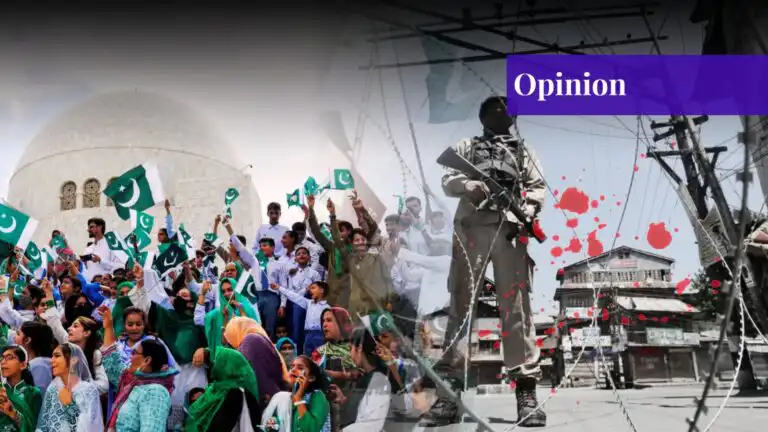
Every year on August 14, Pakistan celebrates its independence. The country transforms into a canvas of patriotic expressions, with streets draped in the colors of pride, echoing the sounds of national melodies. Social media clips, choreographed tributes to Pakistan, go viral, and Freedom Day discount campaigns flood Instagram. In Karachi, Lahore, and Islamabad, euphoria reverberates enough to shake the streets. While freedom is celebrated here, Srinagar sleeps under a sky of silence. Surrounded by drones and concertina, azadi is mourned, not marked; it’s a cry muffled in silence! Arundhati Roy, in an interview with Al Jazeera, said that, “when you celebrate independence, you also mark who has still denied it.”
This contrast is not just about borders, it’s about forgotten pain. Ironically, a country that once fought for its independence is now muted on Kashmir’s repression. The world witnesses one region celebrating and another in grief. We must ask: Who got free? This article is not about waving flags; it’s about standing with those who can no longer declare their freedom aloud.
Partition Was A Border, But Not A Closure
The 1947 partition carved borders across the subcontinent, but not the grief it birthed. Kashmir was not left behind; its fate was put on hold. The subcontinent became the epicenter of unhealed divisions. Kashmir was divided in 1949 by a ceasefire brokered by the UN, but the promised plebiscite remained elusive, carving a narrative of abandonment.
Decades of unresolved tensions turned into generational trauma. According to a historian, Kashmiris have been trapped in an unending violence that has never recognized their rights.
Today after seven decades Kashmir conflict is the one who defines Indo-Pak relations. The question remains what it is like to be born into a battle you never chose, yet cannot escape. Even today, the valley is militarized, promised autonomy is eroded, waiting for a referendum, an unhealed scar that bleeds through generations since partition.
14 August in Lahore, 15 August in Srinagar: A Mirror of Irony
On every 14 August, Pakistan lights up with national pride, the sky twinkles with green and white lights, shops are filled with flags and badges, gatherings for formal ceremonies, gun salutes, parades, flag hoisting, and airborne displays by our second-to-none Air Force-guardians of the sky. Minar-e-Pakistan and F-9 Park of Islamabad are illuminated with blooms, while Lahore celebrates with its special breakfasts of halwa-puri, joy rides on bikes, and music echoing across the earth and reaching the stars.
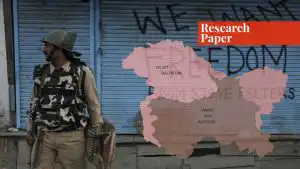
Meanwhile, just one day after, on 15th August, Indian administered Kashmir suffers from curfews and a communication blockade, and the mood sharply diverges. The day is marked by silence, not with joy. There are Fireworks, but not the ones that light up the sky; they explode in the streets. The day is observed as Black Day – a powerful indicator of the denial of autonomy and prolonged occupation.
Qazi Shibli wrote that, “on 15th August, we see, we feel a silence that screams louder than any celebration ever could.”
Digital Freedom, Inherited Silence: Gen Z, Hashtags, and the Azadi Illusion
In today’s digital age, liberty has become a privilege of technological empowerment. Pakistan’s Gen Z celebrates azadi by posting their selfies emblazoned with national emblems and captioning them with hashtags like #Freedom, #AzadiMubarak, etc. While Pakistan’s Gen Z enjoys azadi on social media, the youth of Kashmir live under militarized crackdowns on digital access.
According to the Access Now report of 2023, India has imposed 49 internet shutdowns in Jammu and Kashmir. Professor David Kaye, former UN Special Rapporteur on freedom of expression, said that, “cutting off internet access is a form of collective punishment and a tool to crush dissent and isolate communities.”
In most schools’ syllabus, the Kashmir issue is simplified, leaving no space for criticism. Zehra Zaidi wrote that, “we teach our children to love country, but not always to question its history.” What does azadi mean to a Pakistani youth who has never lived in the harsh conditions in which a Kashmiri youth lives? This comparison is not hypothetical, rather is brutally real. In 2021, a 21-year-old Kashmiri student, Waris Fayaz, was arrested in Pulwama for celebrating Pakistan’s victory in a cricket match on WhatsApp; meanwhile, his peers in Pakistan were freely posting memes and reels and celebrating online. The same digital act becomes an expression of joy in one region and a crime in another.
It’s time to ask difficult questions because truth begins where the hard questions are asked: Can you hashtag #Azadi when someone else can’t even text their mother? Can you truly be free when somewhere else isn’t even visible?
Patriotism or Performance? Our Yearly Ritual of Selective Memory
In Pakistan, nationalism is often termed as patriotic consumerism, neglecting political engagement. Sadaf Khan, media rights activist, said that, “we have reduced patriotism to performances, it’s easier to romanticize the flag than to demand rights for Kashmiris or Baloch.”
A survey in the UNESCO youth paper 2022 revealed that more than 72% university students in Pakistan view Independence Day as a day for social media engagement.
Ailia Zehra, in her op-ed at The Friday Times, noted that “our patriotism starts and ends at symbolic gesture, we rarely ask why Kashmiris cannot post the same photos or wave the same flag without facing persecution.” Thus, we perform patriotism, but forget to practice it.
Who Speaks for Kashmir?
Scripted speech on Kashmir by politicians, journalists, or diplomats paints a picture of national solidarity, but on the ground, Kashmiri voices are sidelined. As per an anonymous producer, “we send raw footage from protests in AJK, but by the time it airs, the narrative is sanitized into token slogans or state-aligned framing”. Kashmir is remembered in slogans, not in solutions. Instead of justice, it gets slogans-the result is patriotic tokenism.
Azadi Is Not A Word, It’s A Fight
In Pakistan, the word “Azadi” (freedom) is often chanted with pride, but for Kashmiris, azadi is not just a metaphor; it’s a fight against prolonged violence. It’s the denial of 4G, the fear of a midnight knock on the door, the mourning of a mother whose son never returned, a buried FIR, and the sorrow of an unidentified grave. We must move Kashmiri solidarity from poetry to policy and from hashtags to human rights.
Pakistanis have romanticized the term azadi by limiting it to slogans and national songs; our youth have shaped it as a tool for branding instead of promoting it as a political demand. It’s time to ask: what does 14th August mean if we continue to ignore the voices that are still silenced? Can a nation truly celebrate its independence when part of it mourns?
You Are Free, but Are You Brave Enough to Talk About Who is Not?
Independence is a responsibility, not a holiday. Azadi is not just inherited; it must be honored, as where freedom is absent, even the educated become spectators, so we must cherish our independence. Every 14th August, don’t just celebrate but interrogate. Speak even when it’s uncomfortable because true freedom is not just about being free, but it’s about standing for those who aren’t. We are free, but is silence in the face of injustice not another form of slavery? As long as others remain in chains, our freedom is incomplete!
If you want to submit your articles and/or research papers, please visit the Submissions page.
To stay updated with the latest jobs, CSS news, internships, scholarships, and current affairs articles, join our Community Forum!
The views and opinions expressed in this article/paper are the author’s own and do not necessarily reflect the editorial position of Paradigm Shift.

Syeda Farani Fatima is an undergraduate student of International Relations at the International Islamic University of Islamabad, with a strong interest in anti-corruption, counter-terrorism and geopolitics. Strongly committed to fighting corruption, terrorism, and supporting national reform through research and public service.