An Overview of BRICS
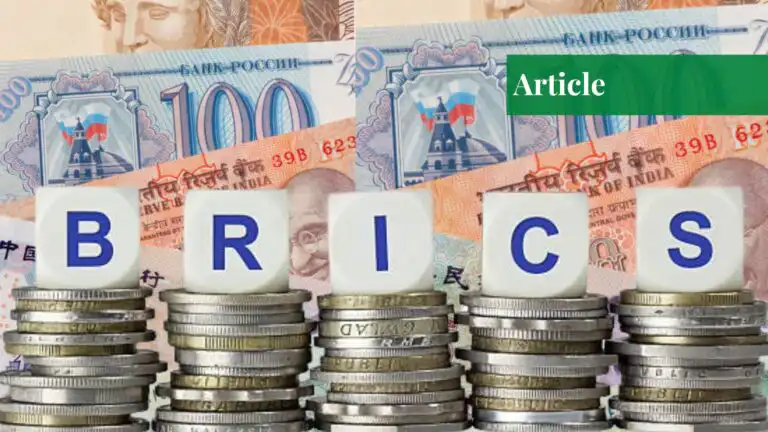
Formed in 2006, BRICS is a formal organization of the governments of several countries. Originally, it was known as “BRIC,” an abbreviation for the countries included at that time – Brazil, Russia, India, and China. South Africa joined later in 2010. The term “BRIC” was devised by Jim O’Neill in 2001 in a research paper. In that research paper, the chief economist highlighted the economic growth potential of the BRIC countries. Back when it was formed, it was not a formal partnership but rather a platform of cooperation between the governments. Currently, BRICS is viewed as a bloc focused on geopolitics to counter Western hegemony.
How BRICS Operates
The first formal meeting to discuss the agenda of BRICS was held in 2009. The head of state of a member nation holds the chairpersonship for a year, and after every year, the chairpersonship is rotated among the member nations. Presently, Russia’s President Putin is the chairman of the organization.
Why Was the Bloc Formed?
Shortly after the Global Financial crisis of 2007–2008, the global South started questioning the aptness and credibility of the global financial system that was led by the United States. Since there was a dominance of the US and Europe in monetary institutions like the International Monetary Fund (IMF) and World Bank, the countries gradually started developing mistrust over these bodies.
Hence, some members of the South formed BRICS with the objectives of increasing economic and political standing in the world and enhancing cooperation in areas including science, innovation, technology, culture, and development. As predicted by Jim O’Neill, in the long run, the BRICS countries want to influence the world economy by 2050. Lately, the BRICS member countries represent almost 40 percent of the world population and 26 percent of the global economy.
BRICS Expansion in 2024
Many countries have shown interest in joining BRICS. The alternative world order that BRICS is presenting to the nations is quite captivating, especially the nations whose voices are kept at bay in West-led organizations like the UN, IMF, etc. The BRICS Summit 2023 announced that six new members would be admitted in the year 2024.
These new BRICS members included the United Arab Emirates, Ethiopia, Iran, Saudi Arabia, and Argentina; although Argentina withdrew its membership application. This decision came into effect on 1st January 2024 and BRICS is now being called BRICS+. Collectively, the members of BRICS+ represent 37.3 percent of the world’s GDP. Pakistan is also looking forward to becoming a BRICS member with the support of Russian chairmanship.
New Development Bank: The Central Bank of BRICS
Up till now, BRICS has formed two important forums. One is the Parliamentary Forum and the other is the New Development Bank. Various parliamentary forums hold meetings with ministers from different departments of member nations to promote and strengthen contact at the leadership level.
The New Development Bank (NDB) was established in 2015. It is a multilateral developmental bank with $50 billion subscribed in capital and $100 billion as initial authorized capital. The main purpose behind the creation of this bank was to challenge the US-led monetary system. Unlike the IMF, the NDB doesn’t have stringent Structural Adjustment Programs (SAPs) as a precondition for getting a loan.
The SAPs have been long criticized by smaller nations and NDB came up with a better alternative. Furthermore, NDB is made with the vision of funding developmental and infrastructural projects in its member nations. It has also provided for a $100 billion contingency reserve arrangement that members can tap into during financial liquidity turmoil.
BRICS and Its Impact on the US Dollar
The US dollar, once a gold-backed currency, has ruled world markets and global trade. As strong as the currency is, the US uses the dollar as a weapon. The strong impact of the US dollar has given the United States government a monopoly over many monetary decisions, including foreign exchange. From imposing uncalled-for sanctions on countries, and imposing trade restrictions to increasing duty and interest rates, the US does it all of its own volition.

The ever-great rivals of the US – China and Russia – have long challenged the United States’ monopoly over the global reserve currency. Hence, for these two states, BRICS is the perfect opportunity for them to do so. Under the BRICS forum, the countries have encouraged each other to trade in their currencies and ditch the dollar. There have also been talks to introduce a BRICS currency to overcome the dollar’s hegemony.
What is the New BRICS Currency?
In the 2023 BRICS summit held in South Africa, there was no official declaration that pointed towards the formation of a new BRICS currency, but the discussion has been going on for a long time on multiple BRICS forums. Within the BRICS, all current members have separate local currencies, so it makes much more sense to have a single currency for trade and other purposes.
It was predicted that this new currency would be announced at the next summit of BRICS in 2024, but former Russian diplomat Yury Ushakov gave an insight into the BRICS currency during an interview. He introduced BRICS Pay, a system of payment based on blockchain technology, although it hasn’t been officially launched by BRICS yet. To put it in simple words, it’s not a paper-based currency but rather a digital one, a cryptocurrency.
The possibility of BRICS Pay being a gold-backed currency is also being hypothesized because there has been a particular increase in gold buying by the BRICS nations, especially China. This common currency will not only be easily accessible for international trade and transactions but also for national and domestic businesses.
Economic Implications of the Common Currency
If this theory is efficiently converted into reality, it will prove to be a giant step towards de-dollarization, and it will most definitely put an end to the reliance on the US dollar. The BRICS currency would introduce a new global reserve currency. The United States will lose control of monetary decisions, and bodies like the IMF and World Bank will need rigorous reforms. The idea of BRICS Pay will make cross-border payments irreproachable, thus, resulting in financial inclusivity and economic integration.
It can also prove to be a substitute for the SWIFT system, henceforth, modifying the global economic landscape. As for BRICS states, they will greatly benefit by not having a foreign sanction or change in interest rate affect their lending and purchasing. Thus, their economic impact will not only be strengthened globally but also prove to be a substantial step towards economic integration among BRICS members.
Geopolitical Implications
Although the shift is already being seen from a unipolar world order to a multipolar world order, if BRICS is successful in its agenda, then it will gain the trust of other nations and, in turn, draw their attention more towards the global South. It will attract more trade and investment from other countries, particularly the Gulf countries. The notion behind BRICS is not just economic but also geopolitical. A recent example is China, which brokered the Iran-Saudi rapprochement to further its geopolitical standing. By bolstering diplomatic ties, BRICS members can bring about and sustain regional stability. Moreover, it will endorse a soft image of the global South to the rest of the world.
Will the BRICS Currency Dethrone the US Dollar?
The currency has not been officially launched yet due to the lack of consent among BRICS members. India, explicitly, has always been at loggerheads with China. Many important initiatives have been blocked by New Delhi on the BRICS platform purely out of rivalry and competition with China and Russia. Another major challenge that BRICS nations might face is providing mass training to their financial bodies to effectively use the new BRICS currency and restructuring their financial institutions and legislation.
The stability of the US dollar has undeniably gained global trust and countries hold their foreign reserves in dollars. No other currency is as liquid as the dollar; hence, it is a safer choice for international trade. Standing against the dollar will be a daunting task. Therefore, BRICS Pay won’t dominate the world in the near future but if BRICS nations resolve their internal political disagreements, then, in several years, the BRICS currency will be strong enough to challenge the US dollar’s dominance.
If you want to submit your articles and/or research papers, please check the Submissions page.
The views and opinions expressed in this article/paper are the author’s own and do not necessarily reflect the editorial position of Paradigm Shift.
Hareem Amna graduated with a degree in applied psychology from GCUF and a post-graduation certification in clinical psychology from Kinnaird College. She is an aspiring writer focused on writing about current issues.