
The US has traditionally had an impact on relations between Iran and India as in the Middle East, Iran is thought to pose the biggest threat to Western interests. Iran is viewed as the region’s biggest opponent by Israel, the US proxy in the area. Iran has suffered terribly as a result of economic sanctions imposed by the US and its liberal institutions, causing a negative impact not just on the nation’s economy but also on its international relations. The Western group has been further enraged by Iran’s admission to the BRICS. This antipathy grew with Iran’s recent counterattacks on Israel.
Owing to the US’s historical practice of abandoning its allies after resolving geostrategic conflicts, India is adopting a middle-ground strategy between the US and the emerging Eastern powers. A friendly and cordial India is essential for the United States to offset the rapidly rising might of China. India is receiving more military hardware and armaments from the United States. India bought $20 billion worth of weapons from the US in 2020, up from $8 billion in 2013.
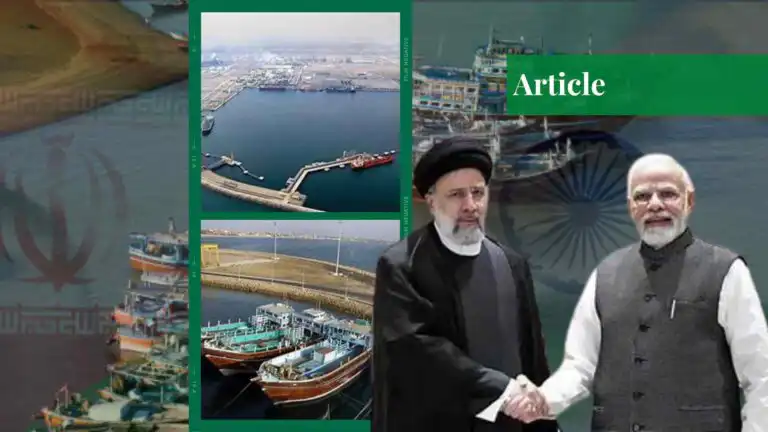
To further its own interests, India has maintained a delicate balance between all regional and global powers. Iran’s Port and Maritime Organization (IPO) and India Port Global Limited (IPGL) recently inked a 10-year deal for the development and management of the Chabahar port in furtherance of this agenda, allowing India to operate its first overseas port at Chabahar. This port has given India access to new commercial opportunities and strengthened the supply network throughout the region. Additionally, it will allow India a chance to reach out to Russian, Central Asian, and European markets.
India’s main source of weapons and armaments has been Russia. Russia has dispatched the inaugural Agroexpress train to India, carrying cereals and oat flakes. A $1.7 billion deal has already been inked by Russia and Iran to construct a railroad that will link Iran, Azerbaijan, and Russia as part of the International North-South Transport Corridor (INSTC). India will thus be able to strengthen its ties and collaboration with Central Asia, Afghanistan, and Russia as a result of its agreement with Iran to develop and run the Chabahar port.
Additionally, India gains substantial leverage over Pakistan with this deal. India may now directly access the markets in Central Asia by avoiding the Gwadar port of Pakistan. Moreover, this will also increase Indian espionage in Pakistan. The Kulbhushan Jadhav case is one of the examples of how India uses its alliance with Iran to conduct terrorism in Pakistan. India has also promised to invest $120 million in the Chabahar port under the terms of the agreement inked between the IPGL and IPO. Furthermore, India has extended an offer of a $250 million loan to improve the Iranian port’s infrastructure.

By the end of 2018, India had initially assumed operational management of the Chabahar port for a two-year, renewable tenure. Nevertheless, the US sanctions had consistently tarnished this accord. Following this new ten-year port arrangement for Chabahar, the US has warned India of impending penalties. The US opposes all collaboration and agreements with Iran. Following Iranian President Ebrahim Raisi’s visit to Pakistan, the latter said that work on the Iran-Pakistan gas pipeline would begin in order to avoid paying a punishment of $18 billion. The US, however, issued Pakistan a strong warning about sanctions.
By imposing economic sanctions, the US persistently tries to thwart any kind of relationship that other nations may have with Iran. Indian Foreign Minister S. Jaishankar said, “I think it’s a question of communicating, convincing and getting people to understand that this is actually for everyone’s benefit,” in response to a query posed by the news reports. He went on to say that the United States had also recognized the greater significance of the Chabahar port.
Due to the ongoing general elections in India, the Indian government is currently unable to withdraw from this agreement under any circumstances. By upholding this pact, India can demonstrate to its citizens that it is a global force that can support the BJP in the upcoming elections. However, because of the US sanctions, the Indian government will eventually find it extremely difficult to carry out this deal. Nevertheless, India can also use the US’s geostrategic importance to circumvent economic sanctions and move on with this accord.
If you want to submit your articles and/or research papers, please check the Submissions page.
The views and opinions expressed in this article/paper are the author’s own and do not necessarily reflect the editorial position of Paradigm Shift.
Ms Maria Sadaqat is pursuing a BSc in Accounting and Finance from IBA, Karachi.