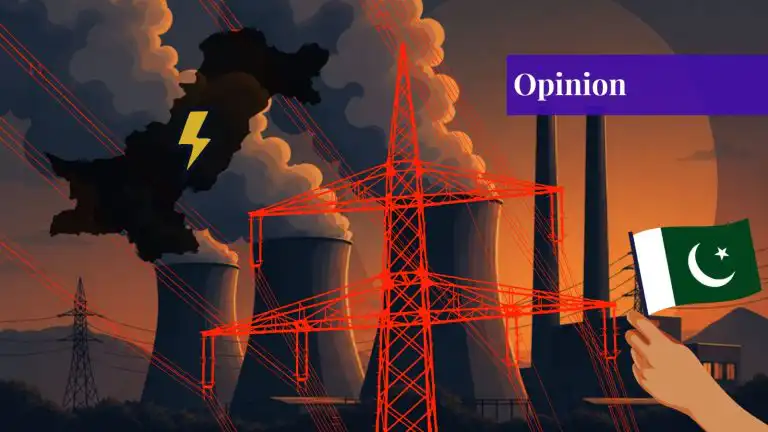
When we talk about Pakistan’s economic condition, it is typically in terms of fiscal or balance of payments deficits or IMF packages. But this masks a more pressing and corrosive reality: Pakistan is deindustrializing. And the core culprit for this is the power sector of Pakistan, aka electricity.
With industrial electricity tariff rates of 15.7 US cents per kilowatt-hour, Pakistan now has some of the highest rates in the region, despite having much lower wages and per capita income than its rivals. The rates in competitor countries such as India, Vietnam, and China are only one-quarter of the rate. The significance of this, however, is sobering: every unit produced in Pakistan is less cost-competitive as soon as it crosses Pakistan’s borders.
This is not an efficiency problem. It is a binding constraint on economic growth.
A Policy on Energy Leads to a Policy on Industry
The evidence suggests that the key variable affecting Pakistan’s industrial performance is the price of energy. Pakistan has had three years of contracting large-scale manufacturing, the loss of nearly 200 textile factories, and a loss of export competitiveness.
Pakistan has already conducted an experiment. When the government introduced regionally competitive energy tariffs (RCET), setting the industrial electricity rate at 9 cents per unit, exports of textiles increased by over 50% in a year. Subsequently, when the tariffs were lifted, exports fell and stopped growing.
The implication for policy is that energy prices are not a background variable—they are the limiting factor for industrial growth. But we still have policies that consider it to be a fiscal stabilizing variable and not a competitiveness variable.
The Deeper Structural Problem
There are four problems. First, Pakistan has a tariff regime that taxes businesses to subsidize other customers. The least cost user, a business, pays more to subsidize residential and agricultural users. This is inefficient: the most efficient user is taxed to subsidize the most politically sensitive users.
Second, capacity is still over-invested. Pakistan has overinvested in generation capacity but is now operating at less than 35% capacity. So, industry is paying for capacity that it isn’t using—capacity charges that now constitute most of the cost of power.
Third, distribution is a secret tax. Losses, theft, and under-recovery in distribution are the equivalent of a massive loss of over Rs 1 trillion annually that is passed on to consumers, which is then passed on by the industry.
Fourthly, and finally, there is no ownership of industrial competitiveness in the power sector of Pakistan. Tariffs are set for cost recovery. Decisions that affect the whole economy—such as removing competitive tariffs—do not consider exports or employment.
This is not just a policy failure. It is a governance failure.

Why Can’t We Do Business As Usual?
In the policy circles, high tariffs are justified on the basis of fiscal considerations. This is misleading. It is more probable that Pakistan has chosen to socialize inefficiencies through the prices of industrial products. This has three implications:
- In the short term, it discourages production and investment. Enterprises either alter the scale of operations, relocate, or establish informal/captive power generation, increasing costs and inefficiency.
- In the medium run, it accelerates deindustrialization. It makes export industries less competitive internationally, as has occurred with textiles, where Pakistan is now lagging behind its neighbors.
- Over the long term, it also threatens macro stability. With weak exports, weak productivity growth, and shrinking formal industry, the very fiscal and external buffers on which it is trying to build are threatened.
So, the status quo is counterproductive.
Another Look at Energy as Industry
A better way to do this would be to debunk the myth that energy is not a friend of industry.
- First, we need to make regionally competitive industrial tariffs a permanent policy. We know that with regional competitive energy prices, exports will follow.
- Second, we must remove cross-subsidies and replace them with income support schemes. The poor should not be protected at the expense of productivity.
- Third, Pakistan must accelerate the shift to competitive electricity markets so that industrial buyers can purchase electricity at contracted prices. This will bypass distortions in the system.
- Fourth, problems in the distribution sector and the circular debt need to be addressed through credible institutional mechanisms rather than recurrent bailouts that are the result of treating symptoms rather than causes.
Finally, the government of Pakistan should institutionalize a process (a power sector and industry policy interface) to guide the regulator in considering economic factors in setting electricity tariffs.
A Narrowing Window
Pakistan’s electricity sector is a paradox: it has excessive generation capacity but very high tariffs. This is not a resource problem. It is a policy choice. But it is a time problem. Time lost is time lost in competitiveness. Factories close, investment relocates, and global market share is lost (and tough to regain). Pakistan has got it right. It’s not a question of diagnosis.
It’s about the state acting in a coherent and consistent way to not hobble the growth sectors. Time is running out.
If you want to submit your articles and/or research papers, please visit the Submissions page.
To stay updated with the latest jobs, CSS news, internships, scholarships, and current affairs articles, join our Community Forum!
The views and opinions expressed in this article/paper are the author’s own and do not necessarily reflect the editorial position of Paradigm Shift.

Dr. Ghulam Mohey-ud-din is an urban economist from Pakistan, currently based in the Middle East. He holds a PhD in economics and writes on urban economic development, macroeconomic policy, and strategic planning.