
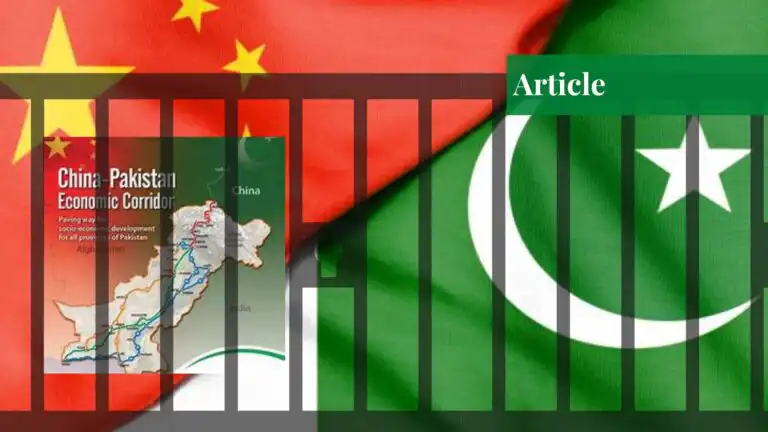
China and Pakistan have a geographical proximity and their friendship is said to be stronger than iron, often labeled as an “iron friendship.” The friendship was said to have become even stronger when both countries signed the CPEC agreement—a project worth billions of dollars—which has raised some serious debates about the potential for a China-Pakistan debt trap.
Introduction
China-Pakistan Economic Corridor (CPEC) is a flagship project of one of the greatest economic ventures of the 21st century called the “Belt and Road Initiative” (BRI). The purpose of this project is to expand Chinese influence to reach the global market as well as to integrate the world’s smaller economies.
The project was announced in 2014 whilst the groundwork started in 2016 after an agreement between the People’s Republic of China and Pakistan. The project is $ 64 billion, making it the epicenter of Pak-China relations. CPEC has benefitted Pakistan in developing its infrastructure, and roads that have increased connectivity and have provided energy-related facilities. The mega-project is often recalled to highlight the interdependence between the two countries.
The “interdependence model” is only one way to look at the relationship between Pakistan and China. However, this project has greater ramifications for Pakistan which the interdependence model cannot describe.
Theoretical Framework
The other theoretical framework used to describe the China and Pakistan partnership through CPEC is the “World System Theory”. It is one where China is taken as the “core” and Pakistan is taken as the “periphery” to describe their relationship. The theoretical framework is applied using the trade relationship and the nature of goods they import or export to each other. The world system theory focuses on the qualitative relationship between the core, periphery, and the semi-periphery. Being a neo-Marxist theory, it also talks about the social change in the world system that has led to class differences and class struggle in the world. It also criticizes the capitalist economic set-up of states.
The relationship between the developed and the third-tier countries or the underdeveloped countries can be best understood with the help of world system theory. The idea of the “World System” was given by Immanuel Wallerstein in 1974 in his paper “The Rise and Future Demise of the World Capitalist System: Concepts for Comparative Analysis.”
Immanuel Wallerstein gave the idea of how the world is divided and how its system works. In this regard, he gave his four-tiered model to categorize the states based on their economic role in the world. The four main divisions of the states are; the core, peripheral states, the semi-peripheral states, and the out-of-system states.
Core: The core states are the developed countries, wealthy, economically, and militarily strong states.
Periphery: The periphery includes the underdeveloped, resource-cursed, states with internal instability.
Semi-periphery: This includes the states that possess an amalgamation of the core and periphery characteristics.
Out-of-system: The fourth category includes the nations that do not have any economic scope for this theory.
He wrote “The Modern World System I: Capitalist Agriculture and the Origins of the European World-Economy in the Sixteenth Century.” By analyzing the economic system of the European world in the 16th century, he developed a detailed view of the world system.
Moreover, the “Dependency Theory” is often linked with the world system. The dependency theory was given by Andre Gunder Frank who talks about the unequal distribution of wealth. The basic premise of the world system theory and the dependency theory is more or less similar in that economic inequality leads to the underdevelopment of the states. However, the dependency theory is more pessimistic towards capitalism whilst focusing on transnational classes and class structures. On the other hand, the world system theory focuses on the states and the inter-state system. The dependency theory is often seen as the precursor theory for world system theory.
The relation between the core and the periphery is such that a two-way process in the periphery provides the core with cheap labor and raw materials. In return, the core provides high-profit consumption goods to the periphery. This relationship provides the ultimate advantage to the core countries. This theory sees capitalism as a world system that is based upon three principles: first, the unequal distribution of global wealth, second, the asymmetry in economic dependence and third, the political inequality.
In contemporary times, there is no naked colonialism but still, there are a few states that form the core and exploit the periphery states. In other words, this is what Kwame Nkrumah (the President of Ghana) termed as neo-colonialism. Neo-colonialism says that the countries are no longer under colonial rule but are ruled indirectly by the influence of the global powers; which is ultimately detrimental to the development of the poor states.
China-Pakistan friendly relations have always been described as an iron friendship. A popular narrative prevails that this friendship has gotten even stronger after CPEC—the flagship project of BRI.
The Sino-Pak cooperation under CPEC will bring infrastructure and development to the country and Pakistan’s economy will thrive. In opposition to this, another notion is that China is pursuing a new form of imperialism in Pakistan through CPEC. If the opposing argument regarding CPEC is considered then the world system theory can best explain the relationship between China and Pakistan. The nature of their relationship is evolving in such a way that China acts as the core country and Pakistan as its periphery. China is taking raw materials from Pakistan and then manufacturing high-end finished goods.
The metal exports of Pakistan have increased, and it has also boosted the mining sector. For example; the export of copper to China has increased since CPEC started. It was nearly $50 million in 2014 and increased to $410 million by 2020. The import of copper from Pakistan has enabled China to meet its demand for copper in manufacturing electronics, solar panels, etc. This showcases the argument of the core-periphery relation of finished goods and raw materials respectively. Pakistan constitutes only 3% of China’s total demand for copper which demonstrates that China is not completely dependent on Pakistan for outsourcing copper. China is using this copper for its developmental and industrial growth.
In return, Pakistan is importing machinery and technological goods. Massive dependence on imported goods has made Pakistan dependent upon China. By 2019, 60% of Pakistan’s imports of machinery and other tech-related goods were from the Asian giant. In this way, Pakistan is being exploited by China and the indigenization of its industries has been hindered. Here, the counterargument is that Pakistan is also getting money from China. However, Pakistan does not have enough exports or revenue to return that Chinese loan, therefore, becoming indebted to them.
Pakistan and China’s partnership is helpful, but the exploitation of certain areas has given rise to problems as well. The citizens of Balochistan are protesting against the violation of their rights due to CPEC—resulting in instability in the province. Moreover, the coal power plants installed by China are adding to environmental pollution. Domestic pollution and global warming have led to the melting of glaciers, and increased temperatures ultimately posing serious threats to the country.
Another factor that proponents of interdependence raise about the CPEC is that this partnership has created or will create job opportunities. The nature of the “jobs” is just cheap labor and that is another feature of the core-periphery relation. The classical relationship between the core and periphery is that cheap raw materials and labor flow from the periphery to the core and high-cost goods and expertise from the core to the periphery.
In this case study, there is no semi-periphery but the example can be India which also has trade relations with China but China could not exploit India due to its economic growth and stability.
Semi-periphery states act as buffers between the core and the periphery. A recent example of Chinese economic intervention is its hold over the Hambantota Port while Sri Lanka pays the loans that the Chinese Government granted it. Now, as the state’s economy has defaulted; China has taken complete hold of the port because Sri Lanka cannot pay the loan. The economic conditions of Pakistan have made it stand on the verge of default and China can do the same with Gwadar Port.
Hence, the world system is a capitalist system that has created differences among the states based on their economic power and has led economically stable countries to exploit the poor countries. As a result, it has made the rich countries richer and the poor countries have become poorer. Few have the power or authority over the resources, technology, etc., which is ultimately causing the disparity among the states, leading to the division of core, periphery, and semi-periphery.
Conclusion
Pakistan has always remained in the category of the periphery states. But the core has changed. Previously, it was the United States that exploited Pakistan for its gains. Now, China has become part of the core, where Pakistan is getting benefits to some extent while China has a greater economic edge and stands to benefit far more from Pakistan.
Pakistan needs to focus on its economic policies (debt restructuring) as well as the indigenization of its industries. This exploitative relationship between the core (China) and the periphery (Pakistan) is one of the reasons why Pakistan remains within the periphery. In light of the above case study, China is pursuing its economic imperialism—a sort of neo-colonialism—in Pakistan.
If you want to submit your articles and/or research papers, please check the Submissions page.
The views and opinions expressed in this article/paper are the author’s own and do not necessarily reflect the editorial position of Paradigm Shift.