The darkest places in hell are reserved for those who maintain their neutrality in times of moral crisis.
Dante Alighieri
The chain of events is triggered by US initiatives, albeit driven by an overwhelmingly Israeli influence, but conflict and events are controlled by Iran since they were always designed to affect Iran’s decision-making. Iran has neither been overcome by them nor affected by them. Iran is not willing to settle for US-Israeli terms. This has frustrated the US as well as Israel, who had hoped on the 28th of February, with the commencement of the Operation Epic Fury, a quick and easy acquittal of Iran was likely. They were wrong.
Epic Fury gradually faded away on the 7th of May 2026, after 62 days, since it did not have the mandatory Congressional approval needed. A grace period of 60 days allowed the President to pursue a conflict in the national interest, but he would need Congressional approval within a 60-day period. The 60 days were up; Congress was not ready to approve Trump’s Iran war. This led to Project Freedom, which started on the 4th of May but petered out after a couple of days on the 6th of May. It was designed to escort commercial shipping in and out of the Gulf but failed and was dropped. We are now sitting on the edge of Operation Sledgehammer, but the real shooting war has not started, though some skirmishes took place when the US bombed Bandar Abbas on May 26th, and Iran retaliated by hitting a US base in Kuwait on 28th May 2026. The new 60-day grace period has not yet started under US Constitutional Laws!
In roughly 90 days of conflict, we hear of US-Israeli rhetoric switch from a 48-hour war, to regime-change, to unconditional surrender, to be given custody of the enriched uranium, to end any nuclear program – civil or military, and now the opening of an already opened Hormuz Strait. The changing objectives and shifting war demands projected by the US indicate a conflict marked by incompetence, total miscalculation, and in search of a strategy – a kind of on-the-job learning. The facts and figures are gradually coming out now and cannot be hidden – destruction to the tune of dysfunctionality of 8 US bases and multiple facilities, including those of NATO, in the Gulf Region, a total of 42 aircraft lost, and the figure keeps rising, an unknown number of dead and wounded, yet to be ascertained, but reported by the Intercept to be around 700. Iran, on the other hand, has lost leadership and infrastructure but was prepared to undergo these losses to protect their sovereignty. The missile launching silos comprising 30 of the 33 batteries are still fully functional, and Iran has 70% of their inventory of what was there prior to the conflict starting. The ceasefire has allowed them to address redundancy through the auspices of the Chinese, and there has been a radical improvement in their air defense systems, cyber warfare, and ballistic missile capacity.
To make sense of what the cost of war has been for the US, a look at the official statistics gives a real story. The Pentagon stated that the expenditure on the war was about $25 billion; independent economists put the figure at $ 63 billion to about $ 1 trillion. The Congress was presented with a defense budget to the tune of $ 1.5 trillion, which is a 50% increase from what it was. The US is now mulling over the merger with the Israeli military through a new law being proposed, i.e., Section 224 of the National Defense Authorization Act (NDAA). Israel knows that the public blowback within the US society, to Israel’s blatant manipulation and interference in US policy-making, is finally coming to an end and that this President and his stay in office will be their last opportunity. The cost indicates the war has not gone too well, the merger indicates that Israel is trying to capture the United States in a life-long bear hug – a parasite living off the US.
The impact of the war on the global economy has been horrendous. It has affected 20% of global oil and LNG. Brent Crude rose from $72 to $120 at the peak of the conflict, while LNG costs rose by 100%. Brent Crude is expected to average at $90 for the rest of this conflict, but could rise if the Straits are not opened. Global growth has gone down from 2.9% to 2.6% as reported by OECD (Organization of Economic Cooperation and Development). Projected losses for this year if the conflict continues are estimated to be about $ 1.5 trillion. Iran, relatively, at this time has the cheapest fuel, i.e., 3 to 5 cents per liter or a maximum of 22.5 cents a gallon. The energy costs are $.002 per kWh. Compared to prices in the US, where it stands at $ 4.30/gallon, and energy is at 18 cents per kWh, Iran is not doing too badly, though there is a substantial economic inflation suffered by the people, affecting food and services. Iran is still selling a substantial amount of oil to the Chinese and Russia through sea as well as land routes.
The US is in the grip of an administration that cannot see reality and remains blinded by Israeli influence. The Trump set-up appears to be led by a man who is suspected of cognitive degeneration and can no longer make cohesive sense of things. His administration is either blackmailed by the Epstein Files and their revelations, or some individuals are heavily bribed by Israel. The style of governance evolves around nepotism, conflict of interest, and insider trading. The foreign policy is in the hands of Steve Whitkof and Jared Kushner, both unelected and Trump nominees who are openly and blatantly supportive of Israeli policies, even at the cost of the US. The US public has had enough, and Trump has lost support all over, but especially from within the Republican Party itself. There is a strong possibility that Trump may lose the mid-term polls and set himself up for impeachment. While the political scenario is fast changing in the US, it is also being linked to the Iran War, and unless Trump can portray some sort of notion of victory, there may be regime change in the US long before it ever changes in Iran. Trump knows this and is in a desperate search for some sort of victory dance.
In Israel, Netanyahu is in a similar position but for very different reasons. He is already an almost convicted man, for whom jail is a definite future location in the event this war ends. It is in his personal interest that the war and conflict go on for some time, eventually securing his political standing. This puts Trump and Netanyahu in a conflictual posture – the former in search of an early end to the war and the latter looking for a prolonged engagement. It has led to a confusing war rhetoric between these two leaders, confounding any firm commitments. In the meantime, Israel has walked into a Hezbollah trap, something they have already experienced in the past when they had to withdraw in 2000 because of Hezbollah resistance. Though the ceasefire included an end to further military incursions in Lebanon, Israel pursued their operations, ignoring calls for peace. However, as they go in deeper, the resistance will get more intense and dynamic – since the Hezbollah are now armed with new weaponry such as the Russian drones. Israel is also hiding the impact of Iranian missiles on their Haifa facilities and Dimona installations, along with the destruction within the cities of Jerusalem and Tel Aviv, etc. Mass immigration and protests have occurred in Israel, not being reported but known to the public in general, which are now showing the resentment people have against the current Israeli Regime. With both regimes under pressure, there is a search for victory in the Gulf, allowing the US to withdraw from the conflict and Israel to end in a better strategic posture that facilitates their concept of ‘Greater Israel’, in the long term.
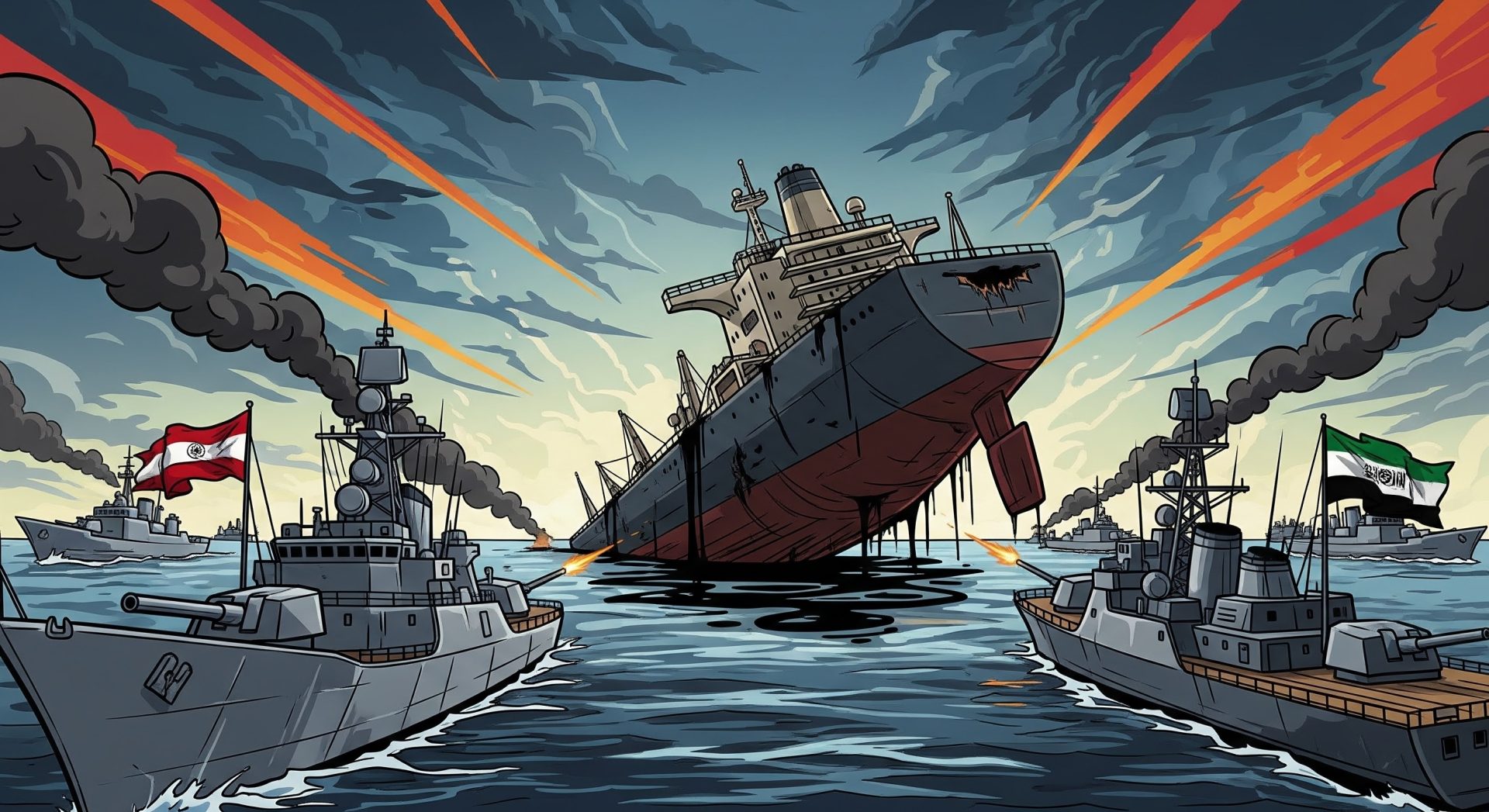
The point now is, how can this victory come about? The current stand-off has turned into a blockade by the US Navy, indicating a siege war. The problem is that siege warfare is time-related, and the process involves exhausting the enemy’s options. In this case, Iran has access through land and the Caspian Sea to Russia, China, and the Central Asian Republics – they cannot be put into an unsustainable position, whereas the US Naval Blockade cannot sustain itself indefinitely. On the other hand, the Global Economy that is being affected so negatively lies at the feet of the United States and has now become its responsibility. This creates the dilemma of strategic orientation – a military term that describes whoever arrives at their military culmination point earlier – loses the conflict. Here, the Iranians have time on their side, sustainability clearly visible, and redundancy under control – the US-Israeli side does not. Thus, Iran enjoys a superior strategic orientation and is not in any hurry to come to a negotiated settlement till it is in their favour. In the meantime, the US wants to end this conflict as soon as it can, whereas Israel wants it to go on for as long as needed. This makes it a three-dimensional conflict with differing national goals, complicating any negotiations even further.
Since the US is leading the application in this conflict cycle, it will have to make the choices that bring an end to this crisis. The sooner the better; the choices are:
- Put in a multi-dimensional shock offensive to get Iran to agree to a negotiated settlement. Iran is never going to allow itself to be beaten into submission; however, the US-Israeli duo will consider it worth a try.
- To keep the blockade in place, hoping that Iran exhausts its potential and gives in. Another unlikely scenario since Iran has much better sustainability in the region than the US-Israel alliance.
- Using a combination of the upper two is a most likely outcome of the immediate stalemate. However, this too does not seem too likely to see success, and Iran’s retaliation may denude the region of power, water, and supply lines.
- The unlikely possibility of going nuclear is another option that appears to be open. Unlikely because of the Chinese and Russian deterrence, as well as their stated ultimatum.
In my opinion, the US- Israeli duo is likely to try scenario one, a surprise attack, intended to take temporary control of the Hormuz Straits, declare victory, and then quickly withdraw. Any fresh Iranian moves to retake control would be blamed on the rest of the world for not doing enough, after the US had done so much for them.
For the US to walk away without any further escalation would imply agreeing to Iran’s demands of lifting sanctions, unfreezing their assets, guaranteeing a permanent peace, leaving the enriched uranium under Iran’s control, relegating the nuclear discussions to a later time, and containing Israel from attacking Iran’s allies, i.e., Hezbollah in Lebanon and Syria, Hamas in Gaza, and the Houthis in Yemen. Now the US cannot agree to these terms, and thus a surprise concentrated attack, i.e., scenario one, is very imminent.
Having assembled the requisite forces and prepared for such an attack during this ceasefire, the US is likely to carry out sea-borne marine attacks on the critical islands at the tip of Oman’s Peninsula and strung across the Straits of Hormuz. These include the following Islands:
- Abu Musa.
- Greater Tunb.
- Lesser Tunb.
- Qeshm Island.
- Larak Island.
- Hormuz Island.
Militarily, other than the Hormuz Islands, all other Islands are critical to physically hold if the Straits must be controlled. It is expected that the Allied forces would conduct deep bombing runs targeting infrastructure, missile sites, and command structures, and hope that the combination of targeting would be enough of an incentive for Iran to concede. Iran is likely to attack the US Navy and shipping, Israel with ballistic missiles, and the UAE with short-range missile systems. The Houthis would be activated, Bab al Mandab would be used to disrupt international communication between the eastern and western hemispheres, global oil and gas supply chains would be disrupted, fertilizer supply would be affected, and other critical raw material halted from going across the world. The Gulf would experience critical energy and water shortages.
The Iranians are past masters of horizontal escalation as opposed to the conventional vertical escalation and will be able to weather the onslaught and yet remain viable. This implies the US-Israeli duo may then fall back to the blockade position as it is now, for another prolonged siege going nowhere – this could result in an endless war. The result would be devastating for the global economy, a dysfunctional UAE, an Israel that would be close to annihilation, and a US in political turmoil domestically as well as internationally. What started as a plan for a ‘Greater Israel’ in control of international trade corridors running through IMEC (India-Middle East-Europe economic corridor) would be a dead dream. It would give in to the Chinese BRI (Belt and Road Initiative). The region would find a new regional peace structure to include Iran, Turkey, and Pakistan with Chinese support and Russian help. The US would have to retreat from the region. BRIC would become a prominent world forum, and SCO would coordinate global trade. The new world order would now be based on a multi-polar complexion where no one would be more equal than any other. The United Nations would lose its significance in its current form; the World Bank would have other alternatives that would not be politicized. Dollar economies would give in to other universally acceptable currencies. The world may become a better place to live in after this crisis is finally done and over with.
For Pakistan to ride this storm, it is crucial to understand that by remaining neutral, Pakistan did itself a lot of good. However, CPEC remains a thorn in the side of the US, Israel, and its allies, i.e., India and the UAE. They shall continue to pursue war by other means to disrupt CPEC at all costs. These attempts would be made through people with real or perceived grievances, leading to insurgencies within Pakistan, i.e., terrorism, violence, and instability. Afghanistan would now become a ready and willing aider and abettor to any such hostile design. If this is not contained now, then as the world celebrates the bounties of a multi-polar world, we in Pakistan may remain relegated to the fringes of human civilization, existing but only surviving – living but simply not yet dead. To address the current situation, the first and foremost recommendation is to hold a free and fair election, allow a popular government to settle in, and to make the people relevant in the running of ‘their’ country. If this is not acceptable, then to put in place a national government, dismiss the present illegitimate government, and ensure that funds and material assets are recovered from all these pretenders, and the IMF stranglehold is addressed. Something must be done; the present system is not going to work, not by a long shot, nor by any miracle.
Leaders who don’t listen will eventually be surrounded by people who have nothing to say.
Andy Stanley
If you want to submit your articles and/or research papers, please visit the Submissions page.
To stay updated with the latest jobs, CSS news, internships, scholarships, and current affairs articles, join our Community Forum!
The views and opinions expressed in this article/paper are the author’s own and do not necessarily reflect the editorial position of Paradigm Shift.