“There is an old observation: ‘God and the Soldier all men adore in time of trouble and no more; when the danger is past, God is forgotten, and the Soldier slighted.’ Francis Quarles. The tragedy is that centuries later, some people still prove its truth. They enjoy the security that others provide and then mock those who provided it.”
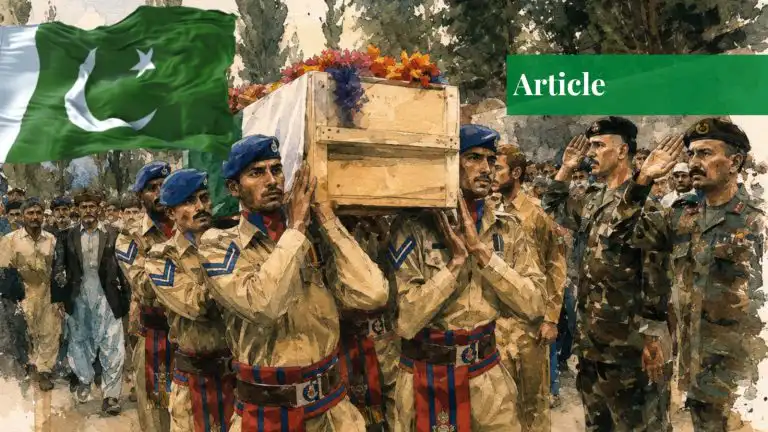
These days I am caught up in the controversy directed at the ‘Shuhada/Shaheeds’ of the Armed Forces. It disturbs me. My heart goes out to the rank and file, the young men and officers, who serve their country with valour, honour, and courage, and to belittle such people is highly uncalled for. Having walked the battlefields of yesteryear in Pakistan as well as outside of Pakistan, with young officers and soldiers, now in my retirement, I cannot allow them to be so insulted without declaring where my loyalties lie. I owe this to the officers, men of the rank and file – I shall always stand with you.
Recently, a politician of a dubious reputation, disguised as a self-appointed religious authority, took it upon himself to insult and belittle military martyrs, the dead and the fallen, who now lie silently and cannot give a befitting reply. He, amongst others in the past, has from time to time drawn mileage by cynical insults and derogatory remarks. I felt I needed to respond – however, my response is for the young men and soldiers of the Armed Forces and not to this person, who can neither comprehend what is said, nor can live by the values they define – all I want to say about him is, that his statements are purely a reflection of his own low standards so don’t let them lower your morale, composure or resolve. Your country needs you. To him, all I have to say is: Criticize power if you must, but do not mistake the soldier for the politician, the sentry for the strategist, or the grave of the fallen for the office of the powerful. When criticism loses that distinction, it ceases to be accountability and becomes prejudice.
Being paid to perform a duty does not diminish the value of the sacrifice when that duty costs a person his life. If being paid cancels sacrifice, then no firefighter, police officer, rescue worker, doctor, or soldier in history deserves respect. By that logic, firefighters are paid to burn, police are paid to be shot, rescue workers are paid to be crushed under rubble, and doctors are paid to die of infectious diseases. Society honours them because duty performed at mortal risk is different from an ordinary transaction.
A salary buys labour and time. It does not buy a human life. Immanuel Kant argued that human beings possess intrinsic worth and should never be treated merely as a means to an end. A soldier may be paid for service, but his willingness to face death for others is a moral choice that transcends a financial transaction. If everything were reducible to money, then there would be no difference between courage and commerce.
The military exists because citizens delegate to a small number of people the dangerous task of defending the community. Most citizens enjoy safety precisely because someone else accepted risks on their behalf. Honouring the military dead is therefore not only about the individual soldier; it is society acknowledging a debt to those who carried burdens most citizens never had to carry. Throughout history, societies have honoured fallen warriors regardless of whether they were professionals or volunteers. Ancient Greeks erected monuments to soldiers at Thermopylae. Romans honoured legionaries. Islamic civilization honoured those who died defending the community – Salahuddin Ayubi, Khalid Bin Walid and Tariq Bin Ziad were not written off from history because they were compensated for their labours. Modern democracies maintain war memorials, remembrance days, and military cemeteries. The common factor is not whether those who lie there were paid. It is that they accepted risks that others would not. Consider two professions: An accountant who is paid
a salary. The risk of death while performing normal duties is extremely low. A soldier who is also paid a salary may knowingly enter situations where death is a realistic possibility. The difference in societal recognition stems from the difference in risk and sacrifice, not from the presence or absence of a paycheck. A soldier is paid to serve, not to die. The salary compensates his work; the sacrifice is giving something money cannot replace. A soldier is paid to stand watch, train, patrol, and fight. If a salary could purchase a human life, every billionaire would be immortal.
The epitaph for the Spartans at Thermopylae: “Go tell the Spartans, stranger passing by, that here, obedient to their laws, we lie.” No mention of pay. What endured for 2,500 years was sacrifice, not compensation. Pericles, speaking of the Athenian war dead: “The whole earth is the sepulchre of famous men.” History remembers those who accepted danger for a cause larger than themselves. John Stuart Mill wrote: “War is an ugly thing, but not the ugliest of things.” His point was that a society unwilling to defend anything eventually loses everything.
The Maulana’s statement confuses compensation with sacrifice. A salary compensates effort; sacrifice is measured by what a person gives up. The ultimate sacrifice is life itself. If pay erased sacrifice, then every widow, orphan, and grieving parent could simply be handed a cheque and told the debt was settled. No society in history has ever believed that. The only people who say soldiers are ‘paid for it’ are usually the people who expect someone else to stand between them and danger. It is easy to dismiss sacrifice when somebody else is making it.
During the Second World War, millions of soldiers on all sides were paid. Yet nations still built memorials from Washington to London to Moscow. Why? Because history understands a distinction that cynics miss: A wage pays for service. Honour recognizes sacrifice. If military martyrs are nothing special because they were paid, then every war memorial should be torn down, every Tomb of the Unknown Soldier should be demolished, every Remembrance Day should be abolished, and every family should be told that a monthly salary was equivalent to a human life. Almost nobody genuinely believes that, because the argument collapses the moment it is applied consistently.
Finally, our holy Quran does not recognise sacrifice by salary. It measures it by intention (niyat), duty, and what a person is willing to give up in the service of a just cause. Wealth may compensate labour, but it cannot compensate for life. For a tribute to our fallen shaheeds, the holy Quran 3:169 and 2:154 are the terms of reference which no self-appointed preacher can ever supersede.
“They shall grow not old, as we that are left grow old; Age shall not weary them, nor the years condemn”
– For the Fallen, Laurence Binyon.
If you want to submit your articles and/or research papers, please visit the Submissions page.
To stay updated with the latest jobs, CSS news, internships, scholarships, and current affairs articles, join our Community Forum!
The views and opinions expressed in this article/paper are the author’s own and do not necessarily reflect the editorial position of Paradigm Shift.