
Finland’s Plan to Buy Mines
Finland hasn’t left the alliance. It has walked out of a treaty; most of its allies still stand inside, and that is the part worth worrying about.
Start with what didn’t happen. Finland has not left NATO, and nobody serious in Helsinki is talking about it. The country joined in April 2023 and has spent the time since proving it is the sort of ally others want in the room. What Finland left was a treaty. The 1997 Ottawa Convention, which bans anti-personnel mines, stopped binding Helsinki on 10 January 2026. This past week, the Finnish army said what it intends to do with that freedom: buy one million of the things for roughly €100 million.
The details are thinner than the headline. Colonel Riku Mikkonen of Army Command told the news agency STT that the plan covers two types of mines, one set off by pressure and the other by tripwire. Finland has about half a dozen firms able to make them. Contracts should be signed by the end of 2027, with domestic production running in 2028. Buying abroad isn’t ruled out, though most of Finland’s defense partners are themselves bound by the treaty and can’t sell. Nothing is signed yet. And in peacetime, the Defence Forces say, the mines sit in storage while exercises use inert training devices instead of live ones.
A million sounds like a plan to carpet the border. Read it as arithmetic instead. According to The War Zone, the purchase would bring Finland’s stockpile back to roughly what it held before it signed the treaty in 2012. That is a restoration, not an invention. Whether you like it is another matter, but the number is less wild than it looks.
The Five Pressures
So why would a careful, rule-abiding country do this? I count five pressures, and none of them works alone.
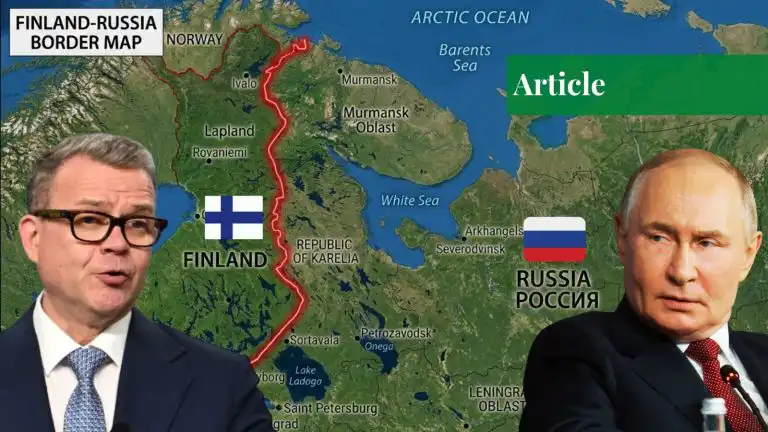
The first is the map, because with Finland it always is. The country shares a little over 800 miles of land border with Russia, the longest NATO has with it, and Finland’s accession more than doubled the length of the alliance’s frontier. Russia answered in 2024 by recreating the Leningrad Military District, which, as The War Zone notes, gives Moscow a dedicated command pointed at this northern sector. Prime Minister Petteri Orpo calls Russia a long-term threat. Long-term, not immediate, and the word choice matters. These mines aren’t being bought for a war next spring. They’re being bought for a Russia that stays hostile and rebuilt for a generation.
Second, Ukraine. The Ministry of Defence says it asked the Defence Forces to study what the war in Ukraine teaches, and that review produced the proposal. Defense Minister Antti Häkkänen said the way Russia fights, their forces, Finland has to look for new approaches. What follows is my reading, not the ministry’s, but the lesson looks like one about depth and delay. A modern army can be watched from the sky and hit from far away, and it still has to cross the ground. Mines are cheap, dull, and brutally good at that last part. Both sides in Ukraine have used them heavily, and Finnish planners can read.
Third, the plain math of being small. Finland can’t out-man Russia and has never pretended otherwise. Its answer is a large trained reserve, conscription, and a landscape of forest, lake, and swamp used as an ally. Under the new plan, every conscript will eventually be trained to use anti-personnel mines. They fit that model like a glove because they turn time into a resource. A few hours’ delay in a forest while reservists get to their positions is worth far more than the €100 million sounds like.
Fourth, company. Poland, Estonia, Latvia, and Lithuania left the treaty alongside Finland. Moving as a bloc lowered the diplomatic price for each of them. Parliament voted 157 to 18, with 24 absent, and the defense minister held the result up as proof of a country acting united and acting swiftly. He had launched the review a year earlier. A vote that lopsided tells you the argument was over long before the treaty exit was formally announced.
Fifth, and here I’m inferring, is insurance. A defence plan is built for the worst day, and the worst day is the one on which help arrives late. The United States isn’t a party to Ottawa either, so no one can say the alliance’s biggest member objects. But Finland’s planners are not designing around the best case. They’re designing around the first days of a fight, when what Finland owns, rather than what it is promised, does the work.
Is Finland Leaving NATO?
Now to the question you asked: is Finland separating from NATO? Formally, no, and oddly, it couldn’t be on this issue, because NATO as an institution has no single position. The US and Russia both stand outside the treaty. Most European allies sit inside it. The friction isn’t at the alliance door. It’s between Finland and the individual allies who signed and kept the pledge.
SaferGlobe, a Finnish research group that opposed the exit, makes the sharpest version of the case. Apart from the US, it says Finland’s main defense partners are bound by Ottawa, the other Nordic countries are staying, and Norway voiced disappointment early. Germany, long a champion of the treaty, said it remains fully bound. German legal commentary adds that serving beside an army outside the treaty isn’t, by itself, assistance in a violation. So the law is manageable. The politics are harder. Picture a German brigade in the Baltics or a Norwegian company in a Finnish forest, rehearsing a defense that includes fields it can’t help plan, can’t help lay, and may someday have to walk through.
That, to me, is the real separation. Not a door but a seam. Finland has chosen to sit slightly apart from its closest partners on one capability, and the seam gets tested the first time planners draw a joint map and one side’s mines are on it. Helsinki says any use will follow specific plans and supervision and that it will be guided by Amended Protocol II of the Convention on Certain Conventional Weapons, a rule it observed even before joining Ottawa. Good. It still doesn’t answer who tells a Norwegian platoon where the fields are.
The critics deserve more than a throat-clearing sentence, so here is their case. The International Campaign to Ban Landmines issued an appeal on 12 October asking leaders to persuade Finland and Poland to drop their production plans. The Red Cross points to the long-term harm, since a mine can’t tell a soldier from a child. SaferGlobe argues the military gain is limited and that the slowing effect has been oversold since at least the 1991 Gulf War. And there’s a point that gets less attention than it should. A defensive minefield is laid on your own soil. If a war comes and ends, it’s Finnish farmland and forest that must be cleared, probably at great cost. Parliament promised to keep backing humanitarian demining abroad, and that promise will sound thinner with a stockpile at home.
I don’t think the decision is indefensible. A country with that border and that neighbor can reasonably want every cheap delaying tool on the shelf. But defensible isn’t the same as costless, and the bill will be paid in trust more than in euros. Helsinki can shrink it. Publish the size of the stockpile in aggregate. Put into law a duty to map and record any minefield laid. Agree in writing with Nordic and German partners how combined plans and exercises treat the mines. Keep the demining money flowing, visibly, even when it is awkward.
If Finland does those things, “separation” stays a word in a headline. If it doesn’t, the gap widens quietly, which is how alliances usually fray. Not with a walkout, but across a long run of ordinary meetings where somebody finally says, “We can’t plan that with you.”
If you want to submit your articles and/or research papers, please visit the Submissions page.
To stay updated with the latest jobs, CSS news, internships, scholarships, and current affairs articles, join our Community Forum!
Find our FREE quizzes and MCQs here!
The views and opinions expressed in this article/paper are the author’s own and do not necessarily reflect the editorial position of Paradigm Shift.

Abrar Hashmi is associated with the Institute of Regional Studies, Islamabad. He is also a student of international relations at Government College University, Lahore.