
Introduction
Regionalism is a political ideology which refers to the collective action of attaining the economic or administrative benefit in a particular area bound by geographical limitations. For regionalism to be successful, the regional agreements and regional treaties were institutionalized to form into regional organizations.
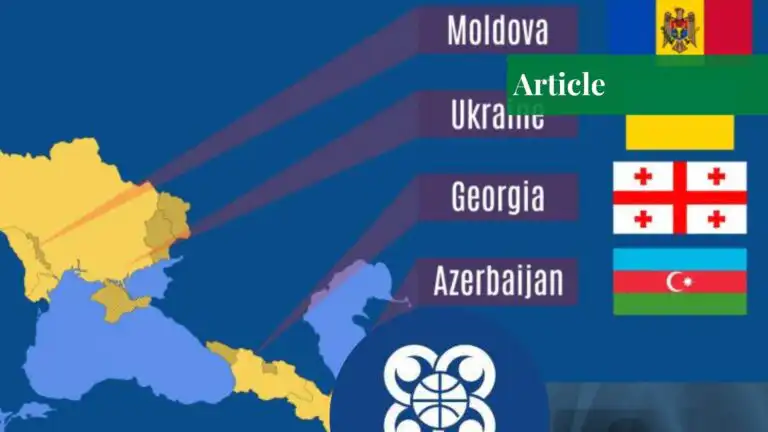
GUAM Organization for Democracy and Economic Development is one example of a post-Soviet regional organization which has passed through several political institutional developments. GUAM includes Georgia, Ukraine, Azerbaijan, and Moldova. Considering the geopolitical dynamics of the region where GUAM operates, GUAM faces a lot of factors which hinder its working towards regionalism.
After the end of Cold War, regionalism slowly came to its zenith. It is imperative, however, to note that the regional organizations came into existence differently in various regions of the world. The contemporary comparative regionalism literature overlooks how various regional norms contribute to the differences in different regions. In regions, social conditions in political mechanisms cause regional organizations to develop divergent pathways.
The role of regional organizations is validated by chapter VIII of the charter of the United Nations. Moreover, regional organizations work on various political, economic, and social levels which help achieve UN goals as well. Another key role of regional organizations is that they develop channels for collaboration with civil society. Regional organizations work together to bring about a space for dialogue between citizens and the civil society organizations.
History of GUAM
GUAM was established on 10th October 1997. The heads of state of 4 post-Soviet states Georgia, Azerbaijan, Ukraine, and Moldova adopted the framework of development and for strengthening stability and security in their region. In 1999, the presidents of the four member states and Uzbekistan met with each other to include Uzbekistan in the regional organization. However, in 2005, Uzbekistan announced its withdrawal from the association.
In 2004, headquarters were established in Kyiv to provide legislative support to the association’s projects of cooperation so that political stability could be achieved along the lines of international standards. However, the current context of GUAM is faced with various issues due to the Russia-Ukraine war.
Organizational Structure of GUAM
If we talk about the structure of the GUAM Organization for Democracy and Economic Development, both the Council and the Secretariat are included in its structure. The main body of the organization is the Council. The Secretariat of GUAM, in accordance with the decisions of the Kyiv Summit, was established in Kyiv and headed by the Secretary General. Before the establishment of the Organizations’ Secretariat, such functions were performed by the GUAM information office in Kyiv.
In 2004, GUAM’s Parliamentary Assembly was established and three committees i.e. science, culture and education; political; trade and economic are included in it. In the organization, the GUAM Business Council operates so that the business cooperation can be developed. Various other Councils include the Council of Permanent Representatives, the Council of National Coordinators and the Council of Heads of States, etcetera.
Many Working Groups and Working Sub-groups in GUAM include the Working Group on Cyber Security, the Working Group on Economy and Trade, the Working Group on Science and Education, and the Working Group on Coordination on Combating Crime. Working Subgroups under GUAM include Working Subgroup on Combating Terrorism, Working Subgroup on Legal Statistics, Working Subgroup on Combating Trafficking in Persons and Illegal Migration, among others.
Objectives of GUAM
The main objectives of GUAM are to ensure respect for human rights, to strengthen democracy and the democratic values, to ensure sustainable development and the supremacy of law, to strengthen regionalism, and to establish humanitarian and economic cooperation. The stimulation of practical interaction and political cooperation in the fields of common interest, the development of technical, transport, humanitarian and socio-economic potential, the improvement of the welfare of states, and to combat extremism, separatism and international terrorism are also some of its objectives.
Geo-political Dynamics of GUAM
Keeping in view the above-mentioned initiatives and projects by GUAM, the presence of China in this region is worth noting here as it benefits the GUAM member states economically. In the contemporary scenario, nearly all member states of GUAM have ongoing or frozen conflicts: Nagorno-Karabakh dispute of Azerbaijan, Crimea and Donbas of Ukraine; Transnistria of Moldova; and South Ossetia Abkhazia of Georgia. Some of these conflicts are influenced by the presence of Russia, while some countries are under the de facto control of Russia.
Although China is not likely to counter the presence of Russia or its activities in this region, there is an implication that the increasing engagement of China with the member states of GUAM can reduce the sense of threat that these states have from Russia, particularly when Russia is left with no other choice but to stay closer to China due to the confrontations between Russia and the West.
Factors Impacting GUAM’s Performance
If we analyze the factors that impact the performance of GUAM in its work towards regionalism, regional conflicts occurring in the territories of the member states is the major factor. For sustainable development and growth in the respective region, these conflicts act as a hindrance. Other than that, they are used as tools to influence and manipulate the member states of GUAM. Hence, it is very important that such factors are persistently as well as collectively addressed by engaging regional and international actors for support.
The region under which GUAM operates is a highly volatile region, given the escalations of the Russian invasion of Ukraine. Also considering the role of Azerbaijan and Ukraine in GUAM, and then comparing it to the number of conflicts they are involved in, reflects the intense volatility in the region impacting the functioning of the organization.
Another factor that impacts the working of GUAM is geographic distance between the states. Ukraine borders with Moldova, while Azerbaijan borders with Georgia and in between there is a geographical distance between the states which makes integration difficult. Moreover, ever since the Russian invasion of Ukraine, not a single official statement from the GUAM has come despite the headquarters being in Kiev.
Conclusion
To conclude, the volatility of the region is one of the most negatively impacting factors of the GUAM which restricts it from working towards regionalism. When analyzing the structural capacity of GUAM, it is built and designed on a thorough framework which can easily be defined as an efficient working body had there not been any regional conflicts.
GUAM is an organization which is in its embryonic phase in its work towards regionalism and the largest impacting factor is the regional conflicts. Therefore, regionalism in the post-Soviet states is a difficult task because these states are extremely volatile, considering the internal and regional conflicts that are present and act as a hurdle in the path to regional integration.
If you want to submit your articles and/or research papers, please check the Submissions page.
The views and opinions expressed in this article/paper are the author’s own and do not necessarily reflect the editorial position of Paradigm Shift.