The untimely death of Iranian President Ebrahim Raisi, Foreign Minister Hossein Amir-Abdollahian, and other government officials in a gruesome helicopter crash has added further uncertainty to the West Asian region. Regardless, Iran has been careful in masking its vulnerability by immediately appointing Vice President Mohammad Mokhber as acting president and Ali Bagheri Kani as the foreign minister.
Analysts quickly pointed out that the Supreme Leader Ayatollah Khamenei is the ultimate silver bullet but Raisi’s tasks of carrying out administrative functions and managing government bureaucracy could not be ignored. He was a favorite and his demise has led to snap elections on June 28, 2024, instead of 2025. Insights on elections indicate that five hardliners and one reformist are in the run. Clear deliberations are guaranteed to select a distinguished political and religious leader.
This article explains the details of the presidential election keeping in view the current political climate of Iran.
Snap Elections in Iran
At least three snap elections in Iran have happened before Ebrahim Raisi’s demise. The period of political flux followed by Raisi’s death was temporarily filled by first vice president Mohammad Mokhber as the interim head of the government as per the Iranian Constitution.
“…In case of death dismissal, resignation, absence, or illness lasting longer than two months of the President,……his first deputy shall assume, with the approval of the Leader, the powers and functions of the President”.
Article 131 of the Iranian Constitution
Moving forward, it is also mandatory that a council—consisting of the speaker of the Islamic Consultative Assembly (Parliament), the head of the judicial power, and the first deputy of the president—hold presidential elections within 50 days. Keeping this in view, the date i.e. June 28th, 2024, was decided by the Ministry of Interior (in charge of electoral processes).
The registration process for the election kickstarted on May 30 in which, around 80 candidates filed for enrollment with the MoI (Ministry of Interior). The list was forwarded to the Guardian Council for further inspection. From June 4 to June 11, after careful consideration, this number was reduced to six candidates. The council then sent the final list to the MoI, for it to be published. The candidates campaigned between June 12 to June 26, followed by a one-day campaign standstill. Finally, the voting day took place on 28th June 2024.
Iranian Presidential Election Candidates
The current presidential candidates include former ministers, parliamentarians, and mayors. The outlook of the five hardliners and one moderate is as follows;
| Presidential Nominees | Brief Portfolios |
| Amirhossein Ghazizadeh Hashemi (Hardliner) – 53 | A staunch supporter of Raisi. He has been previously appointed as vice president and as the head of the Foundation of Martyrs and Veterans Affairs. |
| Saeed Jalili i.e. ‘The Living Martyr’ (Ultraconservative) – 58 | He is a politician and former senior nuclear negotiator. He holds an anti-west stance and has twice run for elections in 2013 and 2021. His election campaign focuses on rural voters. |
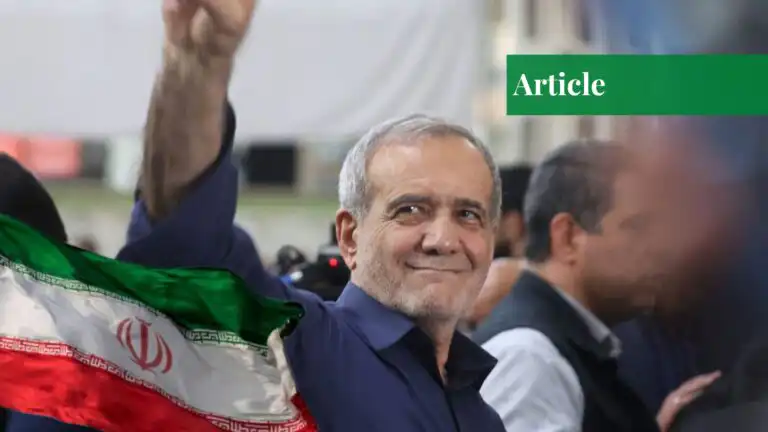
| Masoud Pezeshkian (Reformist) – 69 | The only reformist in the camp with an urge to revive Iran’s bleak economic outlook by striking a nuclear deal with the West. His election campaign focuses on ethnic minorities, women, and the youth. |
| Mostafa Pourmohammadi (Hardliner) – 64 | The Shiite cleric, previously served as interior minister and justice minister. Overall, his election campaign centers on clerics and conservatives. |
| Mohammad Bagher Qalibaf (Conservative) – 62 | The parliamentary speaker had been the leading competitor in the presidential race. He is of the view that strong leadership can help elevate Iran’s status in the global arena. His campaign outlook is based on empowering the middle class. |
| Alireza Zakani (Hardliner) – 58 | The mayor believed that enriching Iran’s economy could help abate the strict sanctions regime by the West. His campaign centers on improving healthcare, establishing a social safety net for the poor, and rescuing Iran’s currency. |
Requirements of the President
To be eligible for the presidential status certain prerequisites need to be followed by the candidate. The age bracket for an individual to appear is between 40 to 75 years. In this case, Article 115 of the Iranian Constitution requires that a candidate must be an Iranian citizen and must possess qualities of trustworthiness and piety. His qualification is centered on a commendable political and religious track record. In addition to this, management abilities and resourcefulness are also assessed before assigning him the presidency. Lastly, he must follow Islamic principles and must be a devout follower of Shiite Islam.
Voting Procedure
All Iranians aged 18 are rightly allowed to vote using their national identification book i.e. Shenasnameh. The time for voting is fixed from 8 am to 8 pm with an extension in the period as per the MoI’s directives.
The election process is based on a two-part ballot system i.e. the ballot itself and the stub portion. The number of stubs and ballots should be equal before the actual count begins. Therefore, when votes are counted the final results are transferred to the executive committee.
The president is appointed based on absolute majority i.e. 50% +1. But if in the case where no candidate avails majority votes, a runoff election is carried out. As it did this year. This takes place between the top two contenders within one week. Once a winner is declared, the Guardian Council gives a thumbs up on the success of the election process. Subsequently, the Supreme Leader signs off the letter of presidency. Lastly, the president assumes office by taking the oath in front of the Iranian Majlis (Parliament).
Role of the President
The President of Iran is the second-highest-ranking authority after the Supreme Leader. He is liable for four years and can hold office for two consecutive terms. In this regard, the president is overshadowed by the Supreme Leader in issuing important decrees based on any matters concerning the state. Nevertheless, the president presides over the executive branch of the government to guide ministers and manage state agencies and departments. He can also choose his cabinet but with the express approval of the parliament.
His overall role is public administration and shaping governmental policies in tandem with the Supreme Leader’s command. Furthermore, the president leads Iran at the international forum through high-profile diplomatic engagements. Moreover, he also partakes in setting the economic and social agenda through public projects. In addition, though limited in nature, he also has some say in inspecting the media discourse.
The Results of the 2024 Runoff Election
Iran’s presidential elections finally declared a winner when the sole reformist Masoud Pezeshkian won against the ultraconservative rival Saeed Jalili in a runoff on June 5. Of the 30 million votes cast, Pezeshkian bagged 16.4 million while Jalili secured 13.5 million.
Voter Turnout in Iran
The voter turnout stood at 49.8%, comparatively better than the 39.92% witnessed in the first phase of the snap elections held on May 28. The 14th administration of elected President Masoud Pezeshkian will commence with an official notification from the Supreme Leader Ayatollah Ali Khamenei, after which he will be sworn into the Parliament as the ninth President of the Islamic Republic of Iran.
In conclusion, the above analysis, of the position of the new president in Iran is valuable. The recent death of Ebrahim Raisi caused a significant psychological blow to the regime. Therefore, snap elections became the need of the time.
If you want to submit your articles and/or research papers, please check the Submissions page.
The views and opinions expressed in this article/paper are the author’s own and do not necessarily reflect the editorial position of Paradigm Shift.