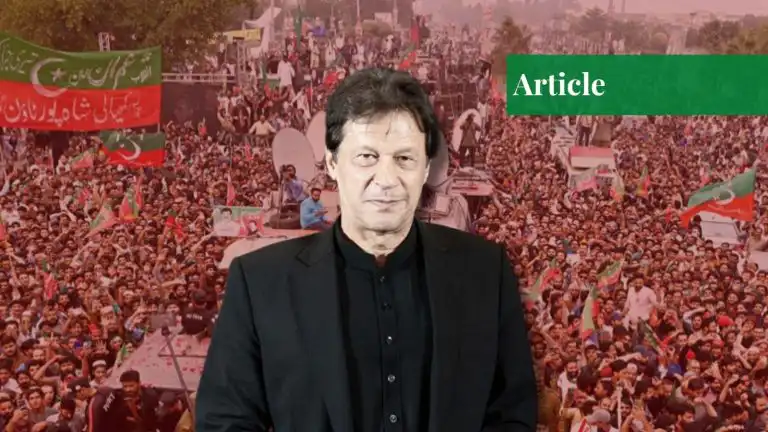
Who was Imran Khan?
“I started this struggle 22 years ago, and today I have been given a chance to fulfill what I dreamed for the country” (Imran Khan, 2018)
Well-known by the moniker of “Blue-eyed Boy of Pakistan Cricket,” Imran Khan played cricket for a long period of time immediately after returning to his homeland, Pakistan, in 1976. He soon became a part of the heart of the national cricket team and was named the captain of the national team in 1982. It was quite interesting that soon after retiring from cricket, he got himself involved in politics and established the Pakistan Tehreek-e-Insaf (PTI).
He kept on playing his role in politics in the coming years and supported General Pervez Musharraf during the military coup of 1999, which made him oppose the general during the presidential elections of 2007. PTI won successfully in the elections of 2013, winning 30 seats in the parliament and ranking second after the Pakistan Muslim League. Later, on 26th July, 2018, Imran Khan ended his cricket career and entered politics and came into power after winning up to 119 seats in the national parliament.
How Did Imran Khan Come to Power in the 2018 General Elections?
PTI published its manifesto on July 9, 2018, and some of its important slogans have been included therein, such as “Road to Naya (new) Pakistan.” Imran Khan promised to build an Islamic welfare state of “Riyasat-e-Madina.” Imran Khan came up with the slogan to ensure zero tolerance for corruption; independence for the National Accountability Bureau; judicial reforms; balance in relation to Balochistan, keeping in mind the views of the people of Balochistan; educational reforms through curriculum change; a budget of 20 percent for education; ten million jobs for young people; and five million houses. All the above points of the manifesto appeal to the young generation as well as the poor/middle-class segment of the society.
What Were the Main Promises of Imran Khan’s 2018 Election Campaign?
The political campaign run by Imran Khan in the year 2018 was tactically designed, with an emphasis on issues that would appeal to the citizens of Pakistan. The key point in his campaign was the firm anti-corruption agenda that he raised as being the main source of all the wrongs happening within the country. The focus of the campaign was on nationalism and sovereignty; he wanted a Pakistan that does not owe anything to any outside power.
Appeals for nationalism and pledges of sweeping economic reforms for economic revival, job creation, and poverty alleviation formed the essence of his campaign. Therefore, through the inclusion of these aspects in his campaign, Imran Khan attempted to win the hearts of diverse groups of people.
What Were the Major Governance Reforms Introduced by the PTI government?
“Good governance is the foundation of sustainable development.” (Kofi Annan)
- Pakistan Citizen Portal
The Pakistan Citizen Portal is an integrated citizens’ grievance redressal system that was introduced by Imran Khan to link all government departments at both federal and provincial levels. This system acts as a medium through which complaints are carried to their relevant offices across Pakistan. The citizens are allowed to give feedback once the complaint has been solved by the officer. Feedback will be tied to the performance of the officer.
- Civil Services Reforms
The PTI government decided to constitute a task force to reform the civil services. The Task Force was assigned the tasks of reviewing all the material available, reports, and recommendations on the subject to recommend changes for the structure of civil services at all three levels of government, namely federal, provincial, and local. To ensure that an APS officer does not stay for too many years in one particular province, a rotation system was introduced. As per the policy, it was a prerequisite that the officer’s first appointment must be made in a province other than the one in which he/she belongs for a period of 5 years in the case of men and 3 years for women.
- Single National Curriculum (SNC)
The Single National Curriculum was launched by the prime minister, Imran Khan, with the objective of incorporating all children of Pakistan into one curriculum program. The curriculum consisted of three distinct phases:
- Phase one consisted of Grades 1 to 5 in 2021-22.
- Phase two incorporated Grades 6 to 8 in 2022-23.
- Phase three consisted of Grade 9 to Grade 12 in 2023-24.
How Did Pakistan’s Economy Perform under Imran Khan?
Khan has not lived up to the lofty expectations that were set for him during his time in office thus far. Khan has been charged with poor economic management, the use of corruption blackmail techniques against political adversaries, and policy flip-flopping, which has undermined all his initiatives. For instance, Khan had frequent clashes with the IMF. Nevertheless, Khan got caught in the same economic cycles that he promised to eliminate. In 2019, he struck a deal with the IMF for a $6 billion loan facility but had to suspend the program. Financial rating agency MSCI demoted Pakistan from being an emerging economy to a frontier one.
With growing pressure from opposition on Khan, the prime minister pledged to lower the price of local fuel and electricity while world prices were increasing. He assured that prices would remain frozen till the fiscal year ends in June. This measure put more pressure on Pakistan’s already existing problem of fiscal deficits and balance of payment issues. Pakistani currency hit record lows versus the US dollar, and the country’s central bank, the State Bank of Pakistan, raised interest rates in an emergency meeting.
What Was Pakistan’s Foreign Policy Vision under Imran Khan?
Pakistan’s foreign policy under Prime Minister Imran Khan had been highly ambiguous. While, on the one hand, Khan emphasized better relations with India as well as more economic cooperation and trade with India, on the other hand, it had also been part of Khan’s priority to maintain support for jihadist Islamist groups such as the Taliban. This was a complete shift from the hostile relationships that had been established in recent times; nonetheless, there were certain levels of tension that existed due to the Kashmir problem, specifically. Under the leadership of Khan, Pakistan also made its military relations with various countries much stronger, and these include Russia, the United States, and China.
- What Was Imran Khan’s approach towards Russia?
PM Khan met with Russian President Vladimir Putin on 24th February 2022 when Russia attacked Ukraine. He said that the reason behind meeting President Putin was that mostly bilateral issues were discussed. The point of view of PM Khan before visiting Putin was that the issue of Ukraine was harmful to everyone and disputes should be sorted out through dialogue and diplomacy. But he never criticized the Russian aggression towards Ukraine.
Another important issue that was brought up during the discussion between Putin and Khan on the bilateral level was the “Pakistan Stream Gas Pipeline Project.” In addition, Pakistan gave permission to Russia to enter the Gwadar Port in Pakistan, which is one of the focal points of the China-Pakistan Economic Corridor projects. The Western sanctions against the Russian firms and banks could impact the bilateral project. After the Khan’s visit, it was revealed that Pakistan would buy two million tonnes of wheat and also natural gas from Russia.
- What Was Imran Khan’s Approach towards China?
Since Imran Khan became the prime minister of Pakistan in August 2018, there has been an apparent intention on the part of the latter to strengthen the relations between the two countries. This has been proven by the fact that his first official international visit was to Beijing. Moreover, Imran Khan expressed a willingness to build better relations with India as well, making a stop in the capital of the country while returning from his trip to Beijing. Neither China nor India has reciprocated the gesture yet. Given the history of relations between China and Pakistan in the field of geopolitics, it is reasonable for both of them to maintain cordial relations for further cooperation.
- What Was Imran Khan’s Approach towards Afghanistan?
The invitation of the President of Afghanistan to Pakistan was among the earliest notable actions of the newly elected prime minister of Pakistan. The resolve of both the presidents to improve relations and work for peace has been evident from the press conference they held in Kabul, Afghanistan. In spite of all this, there were several reasons why Imran Khan’s government could not manage to mend its ties with Afghanistan.
Mutual distrust and suspicion prevented the two nations from fostering dialogue and cooperation. The existence of the Durand Line continued to be an unresolved matter as Afghanistan did not acknowledge this line as the official boundary between the two countries. Terrorist outfits that worked in Pakistan posed another obstacle for maintaining positive ties with Afghanistan. There were also external forces that interfered in the region and had a negative impact on their relations.
How Did Khan’s Era Come to an End?
The three-and-a-half-year term of Imran Khan as the prime minister of Pakistan was brought to an abrupt close on April 10. His government was ousted in a motion of no confidence against him, which is a normal constitutional method to remove any prime minister who has lost his majority in the legislature in a parliamentary democracy. But this was the first such instance in the history of Pakistan when the prime minister was ousted by way of a constitutional procedure and not by way of military intervention or through a court order. With his opponents pressurizing him and facing the prospect of losing his parliamentary majority, Khan used his populist rhetoric to insult his opponents as the “enemies of the people,” indulging in horse-trading, and calling them ‘thieves’ and ‘rats.’
While the military promised to remain neutral in the face of such an eventuality, Khan ridiculed its promise of neutrality (as, per him, “only animals are neutral”) and considered it treachery. While the military had abandoned Khan and the judiciary would not toe its line, the frustrated Khan adopted yet another populist strategy. This time Khan charged the opposition with being in cahoots with some “foreign power” and trying to oust him. While addressing his followers during a protest rally right before the no-confidence vote was scheduled to be cast, Khan showed a piece of white paper saying he had evidence of threats from a foreign state in the event of his following an independent foreign policy.
FAQs
On May 9, 2023, former Prime Minister Imran Khan was arrested on corruption charges, triggering nationwide, violent protests.
Imran Khan’s political ideology is a blend of Islamic populism, social welfare, anti-corruption, and an independent foreign policy.
Pakistan’s Gross Domestic Product (GDP) reached approximately $375 billion to $383 billion in nominal terms by the end of Imran Khan’s government in the 2021-22 fiscal year.
Former Pakistani Prime Minister Imran Khan has faced over 150 legal cases since his ouster in 2022.
Former Pakistani Prime Minister Imran Khan is currently imprisoned in Adiala Jail in Pakistan, serving time on multiple convictions, including corruption.
Imran Khan is credited with launching landmark welfare programs listed below:
1. Sehat Sahulat Program (providing universal free healthcare)
2. Ehsaas Program (poverty alleviation).
3. Ten Billion Tree Tsunami for environmental conservation
4. Kartarpur Corridor for Sikh pilgrims.
If you want to submit your articles and/or research papers, please visit the Submissions page.
To stay updated with the latest jobs, CSS news, internships, scholarships, and current affairs articles, join our Community Forum!
The views and opinions expressed in this article/paper are the author’s own and do not necessarily reflect the editorial position of Paradigm Shift.

Syed Hammad Ali is pursuing a BS in International Relations programme from the International Islamic University, Islamabad, and has a keen interest in research works, policy analysis, defence and strategic studies, and conflict resolution.