Colonial Foundations and the Shift Toward Regional Training
Both the Pakistan and Sri Lankan armies came into existence by virtue of colonialism, in which the British military traditions galvanised the command structure. Despite sharing a common bond with British roots, both armies had different destinies in serving their motherlands. Yet, in contrast to these differences, the deeper ties between the Sri Lankan army and the Pakistan army are worth remembering as one of the strongest pillars of bilateral relations between the two countries.
In the first two decades after independence, the duties bestowed upon the Sri Lankan army took a rather ceremonial manner, emulating the colonial ethos, and the commanders of the Sri Lankan army were British nationals until 1955. However, the massive political transformation that occurred in 1956 compelled the armed forces in Sri Lanka to get rid of their quasi-European characteristics, which resulted in reducing the number of officer cadets sent by Sri Lanka to the elite Royal Military Academy Sandhurst in the United Kingdom. The indigenisation of the army, along with the financial constraints that surrounded post-independent Sri Lanka, compelled the government to send its officer cadets to less expensive and effective military training schools in the region.
In this context, several young Sri Lankan army officers were sent to the Pakistan Military Academy in 1963, marking the beginning of a longstanding relationship between the two armies. Among the first group trained at the academy was Srilal Weerasooriya, who would later become the commander of the Sri Lankan Army. The professional relationship that Weerasooriya, later a general, developed with Gen. Pervez Musharraf proved significant decades later when both held senior leadership positions.
Camaraderie and the Elephant Pass Crisis
In 2000, as the strategically vital Elephant Pass army camp complex faced imminent capture by LTTE forces, troops under General Weerasooriya established a defensive line in Muhamale. However, mounting an effective resistance was extremely challenging without substantial firepower. At that time, the Sri Lankan army’s firepower was limited to artillery, which was insufficient to counter the LTTE offensive. Consequently, the acquisition of multiple barrel rocket launchers (MBRLs) became critical.
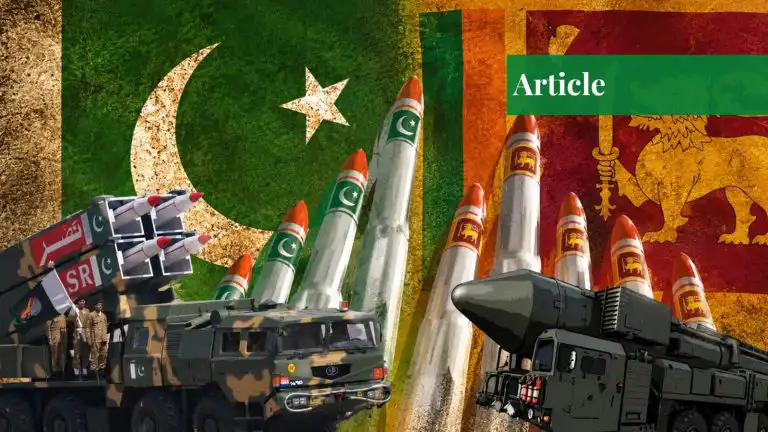
The longstanding rapport between General Weerasooriya and General Musharraf, established during their training at the Pakistan Military Academy, became instrumental. In response to General Weerasooriya’s urgent request, General Musharraf arranged for the delivery of 30 MBRLs to Colombo within a few days, significantly altering the course of the conflict.
Early Diplomatic Support
To understand the strong ties between the Sri Lankan army and the Pakistan army, one needs to revisit Sri Lanka’s lesser-known assistance given to Islamabad in 1971 during the Indo-Pak war. In 1971, when Pakistan requested refuelling facilities from Colombo for its aircraft flying to East Pakistan, the request was granted by then Sri Lankan Prime Minister Sirimavo Bandaranaike, regardless of its subsequent geopolitical effects.
The bonds between the two armies became much sharper in the turbulent 1980s when Sri Lanka began to confront the LTTE terrorism at an unprecedented level. In the words of Sri Lanka’s renowned military historian Channa Wickremasekere, this period was a tough apprenticeship for the Sri Lankan army that was transforming from its ceremonial role into a fighting force, and the new armed technology became a pivotal need for Sri Lankan forces to cope with this new enemy. The firearms used by the Sri Lankan army in the early 1980s lacked the capacity to crush. The heavy arms of the Sri Lankan army consisted of a few Saladin armoured cars purchased from Britain in the 1950s, and the artillery regiment, which was reduced to a single regiment after a 1962 coup attempt, had a few 76 mm mountain guns acquired from Yugoslavia and Britain.
To boost the morale of the armed forces, the Sri Lankan government under the Presidency of J.R. Jayawardene made several requests to various Western states, but to no avail. In the backdrop of such a twisted context, Colombo’s request to Islamabad was warmly reciprocated, followed by the dispatch of a heavy load of firearms and other military equipment to intensify the Sri Lankan armed forces’ attempt to thwart the LTTE’s activities.
Institutionalizing Modern Cooperation
It should be noted that the ties between the two armies have been fostered not mainly due to diplomacy. On the contrary, the personal friendship fostered between the gentlemen officers from both armies has played a catalytic role in cementing the relationship, which continues to this date. For example, in 1976, when Gen. Zia-ul-Haq visited Sri Lanka as Pakistan’s Chief of Army Staff, then army commander of the Sri Lankan army, General Sepala Attygalle, made a good rapport with Gen. Zia. 10 years later, when Gen. Sepala Attygalle requested armed assistance from Pakistan, it was gently accepted by General Zia-ul-Haq, who was then in power as the President of Pakistan, proving how person-to-person approaches can be very effective in international affairs.
In the fourth Elam War, when international pressure began to weaken Sri Lanka’s armed forces’ humanitarian operations in the North and Eastern provinces of the island, Sri Lanka sought urgent armed supplies from Pakistan. In particular, $25 million worth of 81 mm and 120 mm mortar ammunition was delivered to Sri Lanka within the month’s request, which forged the last offensive of the Sri Lankan armed forces in eliminating the LTTE menace.
According to Janes Defence Weekly, the total defence purchase from Pakistan reached up to $100 million by the end of 2008. On the advent of the complete military defeat of the LTTE, in January 2009, a meeting between Pakistan Defence Secretary Lt Gen Syed Athar and his Sri Lankan counterpart, Gotabaya Rajapaksa, paved the path to enhance cooperation in military training between the two armies. In that context, besides sending officers to the traditional Pakistan Military Academy, Sri Lankan Army officers began to receive their training in other prestigious military academies in Pakistan, such as the School of Artillery in Nowshera and the Command and Staff College in Quetta.
All in all, the stronger ties between the Sri Lankan Army and the Pakistan Army reflect the warmth of the bilateral relations between the two states under all circumstances. Yet the bond between the two armies stands unique, as it is a sheer embodiment of trust between soldiers built on shared experience, personal stories, and nostalgia.
If you want to submit your articles and/or research papers, please visit the Submissions page.
To stay updated with the latest jobs, CSS news, internships, scholarships, and current affairs articles, join our Community Forum!
Find our FREE quizzes and MCQs here!
The views and opinions expressed in this article/paper are the author’s own and do not necessarily reflect the editorial position of Paradigm Shift.

Punsara Amarasinghe is a former post-doctoral researcher affiliated with Scuola Superiore Sant Anna (Sant Anna School for Advanced Studies), Pisa, Italy. He is a PhD holder in Public International Law from the Institute of Law, Politics and Development at Scuola Superiore Sant Anna. He holds an LL.M. from the South Asian University, New Delhi, and completed his undergraduate studies in law at the Faculty of Law, University of Colombo, Sri Lanka.
He completed another master's degree in international relations from the HSE, Moscow. He has held two visiting research fellowships at the Global Legal Studies Centre at the University of Wisconsin, Madison, and Sciences PO, Paris. He was affiliated with the Minerva Center for Strategic Studies at Hebrew University, Jerusalem, for a brief period in 2019.