The opening of this decade brought back a problem for Pakistan that it thought it had finally overcome: the resurgence of terrorism. What was initially just seen as the fallout of the scurry of world superpowers to establish control in south-central Asia via proxy wars became a major issue for Pakistan’s security. Terrorism spread like an epidemic, with fatalities through terrorist violence rising from 45 in the year 2000 to 11,704 in 2009, according to the South Asian Terrorism Portal Index (SATP). But it was the 2014 incident in Peshawar that brought about a dedicated political and military crackdown on terrorist factions, and peace was eventually restored. At least that is what the Pakistani people had thought.
Pakistan is facing a new wave of threats from terrorist factions—groups it spent a lot of money and, more importantly, precious lives trying to get rid of. Expert analyses of this new wave of terrorism in Pakistan usually span three main causes: the Taliban resurrection, the organization of insurgency in Balochistan, and the ever-lasting political instability. But there is something else we’ve been ignoring: a more systematic look at the issue at hand. An understanding that ties together all the problems leading up to this epidemic rather than looking at them as separate, disparate issues—institutional – institutional weaknesses.
The Taliban Resurgence
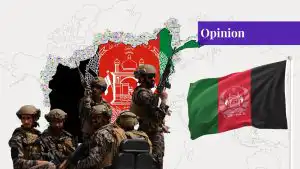
The lack of stability and enforcement by the state institutions has facilitated an environment for all the state and nonstate components to allow terrorist organizations to operate—for example, the resurgence of the Taliban, particularly the Tehrik-e-Taliban Pakistan (TTP). Among many factors, this new wave of terrorism has thrived on the state fragility in Afghanistan post-Taliban takeover in 2021.
As the Taliban took over parts of Afghanistan, they crumbled the already dwindling state, perpetuating lawlessness within Afghanistan. The new leadership, which the Khan-led government had initially referred to as Afghans having “broken the shackles of slavery,” proved far less cooperative than what they had anticipated. The Taliban administration began taking measures like releasing thousands of imprisoned TTP, Al Qaeda, and ISIS terrorists, according to news reports.
This automatically led to a surge in terrorist attacks within Pakistan, particularly in the northwest of the country. Militants began using Afghan soil to carry out attacks within Pakistan. The incidents increased from 136 in 2019 to 268 in 2021 and then 365 in the following year, according to the SATP. Additionally, the ability of TTP to get involved in other parastate activities like extortion and carry out systematic attacks on both security forces and civilians is a clear indicator of weak institutions within Pakistan.
Weak Institutions
The continued fragility of the Pakistani state toward its western borders has cultivated an environment where TTP can resurge, despite its resource-heavy operation earlier to purge the terrorism problem. Other reasons for this rise include the absence of state welfare in these regions. This has led to terrorist militants forming an ecosystem within Pakistan’s borders that has become stable enough to repetitively withstand government clampdowns.
The Pakistani government’s frustration over this has also manifested in its use of kinetic power. The government has conducted various cross-border operations and airstrikes, which have consistently led to civilian deaths, bringing wrath from the Taliban government. The recent air raids on December 24, 2024, also claimed the lives of 46 people, including 15 women and children, as per the initial reports. This has also brought condemnation from the Afghan government and only increased the probability of their support for the terrorist factions.
Unfortunately, this quagmire isn’t the first security situation Pakistan has faced since its involvement in the 1979 war. We have seen waves of security threats that have been attributed to many different causes: TTP and other religious extremist groups, Pashtun movements and insurgencies, and even cross-border mischiefs from Indian intelligence based across our western border.
But what we have failed to recognize is the very consistently weak institutions within Pakistan. The concept of institutionalism here refers to the ability of state organizations to constrain individual behavior and bring legitimacy to the power they hold. This concept also considers the degree of compliance the Pakistani government can ensure with the laws within its territory and how stable and consistent it has been in response to major shifts in state equilibrium.
Using this lens to take a look at the resurgence of terrorism in the country helps us connect all the individual events rather than treating them as isolated instances with unique causes and circumstances. The factors that made northwest Pakistan a safe haven for the Taliban to make up a parastate in the 90s are alarmingly identical to the factors contributing to this resurgence.
The institutions in Pakistan are hence working in a trajectory where they fail to contain power vacuums and political instability, worsening the security situation time and time again. We are observing a cycle of violence that must be brought to an end, and for that, we need to strengthen our institutions—not just militarily—but through governance-related and socioeconomic reforms that bring long-term stability and peace.
If you want to submit your articles, research papers, and book reviews, please check the Submissions page.
The views and opinions expressed in this article/paper are the author’s own and do not necessarily reflect the editorial position of Paradigm Shift.

Zainab Kashif is a bachelor's student of public administration at NUST, Islamabad. She is passionate about geopolitics and policy preparedness.