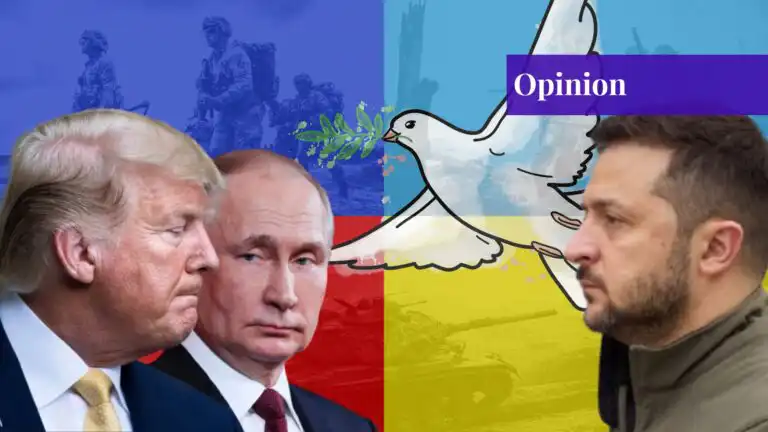
During a recent exchange, Donald Trump’s fiery statement to Ukrainian President Volodymyr Zelensky, “You are not in a position; you don’t have cards,” unveiled a grim geopolitical reality. Whether intentional or unintentional, this statement unearths a skewed geopolitical order. This statement exemplifies a classical truth in global politics in the power hierarchy: the strong dictate, and the weak comply, “The strong do what they can, and the weak suffer what they must.” On the other hand, Donald Trump has repeatedly claimed that he could swiftly end the Russia-Ukraine war, portraying himself as a peacemaker.
However, this unwavering support raises many questions: Is the US helping Ukraine achieve lasting peace, or is it prolonging the war in pursuit of its strategic interests? A significant reality emerged from the contentious discussion between Ukrainian President Volodymyr Zelenskyy and President Trump on February 27, 2025, highlighting that Ukraine is defending its sovereignty and possesses many precious resources that the US is interested in utilizing.
 You will find more infographics at Statista
Trump’s line about workers “digging, digging” for raw materials in Ukraine goes beyond a simple remark. It reveals the economic and strategic reasons behind the US’s connection to the country. Home to a treasure trove of rare minerals, Ukraine stands at the crossroads of technological advancement and great power rivalry.
Referring to the disbursement of high-tech weaponry at different places meant that the economy did not always figure out the focal axis in acquiring the necessary resources to uphold technological superiority.
 You will find more infographics at Statista
Those who are part of the broader context of China and US competition over rare-earth minerals needed for semiconductors, future defense systems, and decarbonization technologies are only magnified. With this, the United States is scaling up investment in Ukraine’s resource extraction to support its partner and gain strategic supremacy over China. This move saved military and industrial superiority in the multipolar international order.
Born from the harsh realities of world politics, the statement by Trump to Ukrainian President Volodymyr Zelenskyy that you are not in a position to do this, you do not have the cards, draws attention to the fact that sovereign nations often yield to the strength of more powerful countries, and strength is the currency. This statement lays bare a grim geopolitical reality: Ukraine has no control over its fate from Washington, Brussels, and the halls of international decision-making, which develop plans to defend Ukraine and other geopolitical interests. This is not a coalition of equals. Its US-led governance is masked as an alliance. The power dynamic makes it clear that “The strong do what they can, and the weak suffer what they must” echoes the terrible realities of history. With the help of its enormous military and economic might, the United States is influencing the circumstances in which Ukraine battles, negotiates, and eventually lives. Instead of waiting for policy decisions in Washington, Ukraine would set the conditions for its involvement if it acted with true sovereignty. This disparity in power is about governance, not just military support. This raises fundamental questions: is Ukraine genuinely engaged in a struggle for its fate, or is it only a pawn in a far more extensive geopolitical conflict? At its core, this conflict is about geopolitical dominance. It is about safeguarding resources, enhancing power, and projecting power on the global stage.
Trump’s words betray strategic intent beyond mere diplomacy to a power structure in which the United States controls Ukraine, manipulates its fate, and monopolizes the resources and assets to reinforce its global military and technical superiority. Phrases like “large investments” and “high-tech weapons” imply that Ukraine’s worth is increasingly determined by its usefulness in the larger great-power conflict rather than by its autonomy. The reality is stark and undeniable: Ukraine’s land, resources, and strategic location are exploited in the global power struggle and transition from sovereignty to the battleground for superpower interests. Peace is a means to an end, but power is a true objective. The militarization of Ukraine and American economic interests in its natural resources imply that control, not genuine peace, should be the first goal.
War in Ukraine is no longer just about sovereignty; it’s a pawn in a global power struggle, where major countries control the battlefield to seize vital resources, establish technical superiority, and expand their worldwide supremacy rather than aiming for true peace. Ukraine’s vast lithium, titanium, and rare-earth mineral reserves. Make it a target for economic exploitation. Ukraine’s sovereignty will remain a comfortable illusion, and true peace will remain an unachievable dream until it can take charge of its destiny and break free from the predatory hold of more powerful states. This is a war for economic conquest, power, and domination, not for Ukraine.
If you want to submit your articles and/or research papers, please visit the Submissions page.
To stay updated with the latest jobs, CSS news, internships, scholarships, and current affairs articles, join our Community Forum!
The views and opinions expressed in this article/paper are the author’s own and do not necessarily reflect the editorial position of Paradigm Shift.

Ibrar Hussain is an MPhil scholar in International Relations at the National University of Modern Languages (NUML), Rawalpindi Campus. His academic focus revolves around strategic studies, nuclear deterrence, and regional security. Through his research, Ibrar critically analyzes the doctrinal postures of India and Pakistan, emphasizing how ambiguity plays a central role in their nuclear policies and deterrence strategies.