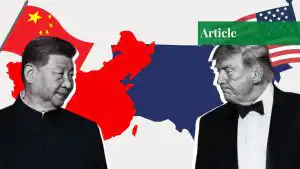
The news headlines called it a victory, a “trade deal” that would start a new path for our country’s economy. The promises were huge: a partnership to find our hidden oil, a place (maybe KPK) at the table, and a share in our own prosperity. But the celebration didn’t last long. The final agreement came not as a gift, but as a punishing tariff—a 19% tax on the goods we sell to America. This was more than just a tax on our trade; it was a direct tax on our hope, a heavy cost on the hard work and dreams of our people.
Let us be honest about what really happened. A good deal is an agreement made with respect and mutual benefits. This was not that. It was, instead, pressure hidden as a polite deal. We were tempted by the promise of oil wealth—a treasure map to reserves that might not even be there. In exchange for this distant whisper, we paid a very real, very immediate price. We were given a risky promise and, in our rush to believe, we gave up a sure thing in our economy. The deal looked good, but we failed to see what it really was. It’s unclear if we will even be able to negotiate more.
What does this 19% tax really mean for an average person? It’s not just a number on a computer screen. It is the cost of every shirt woven in Faisalabad, the last stitch on every soccer ball from Sialkot. It is a four-dollar penalty added to a twenty-dollar item. Our businesses, already fighting a tough global battle, have been pushed even further back. This means less money for our exporters, fewer jobs for our local workers, and more and more worry for countless families. It’s a direct hit to the very engine we need to get ourselves out of debt. This tax is not a financial problem for us; it is a mental one, hurting the feeling of security that comes from honest work. It creates a feeling of unease, where the economic future feels less like a path forward and more like a dangerous walk over a deep hole.
And what did this cost really get us? The talk of “massive oil reserves” is little more than a ghost on the horizon. The promise of possible oil has been part of our national talk for years. The money needed to find and extract it is huge, and it would take years to get a single drop of crude, if it’s even there. In the excitement of the announcement, our officials were so focused on this fake promise that they missed the real loss. We listened for what we wanted to hear and ignored the reality of what was actually said.
This event forces us to take a serious look at our foreign policy. For too long, we have acted as if we are playing a game of musical chairs, always looking for someone new to help us. This “transactional diplomacy” is not a smart new way of doing things; it’s a dangerous return to a bad habit. It makes us very open to being hurt by the changing moods and demands of powerful nations. We are now in a position where we are trying to keep both our strong partner, China, and America, which changes its mind a lot and only cares about deals.
We saw our leaders quietly celebrating when the same administration put a 25% (now 50%) tariff on Indian goods, seeing it as a sign of favor. But this was never a sign of a lasting friendship, only a warning. Our own 19% tariff proves that this kind of diplomacy is a game of shifting winds, where today’s friend is tomorrow’s target. The way to real strength in this kind of world is to make ourselves so important that others have to deal with us on fair terms (like China). This means we have to look at ourselves. We must focus on our own strength, our own businesses, our own people, and their education. A country that makes its own value, instead of just asking for favors, is a country that earns respect. The 19 % tariff is not a financial burden; it is a big lesson for us. The time for fake promises is over. Our real strength will be found not in a foreign deal, but in the reality we build for ourselves, with our own hands, from within.
If you want to submit your articles and/or research papers, please visit the Submissions page.
To stay updated with the latest jobs, CSS news, internships, scholarships, and current affairs articles, join our Community Forum!
The views and opinions expressed in this article/paper are the author’s own and do not necessarily reflect the editorial position of Paradigm Shift.

Arslan Mirza is pursuing rhetoric at Harvard University to master the art of persuasion. As an independent researcher with over 10 years of experience, he has published more than 1,200 articles and over one million words in numerous US-based publications. You can reach him at mirzanoir@gmail.com.