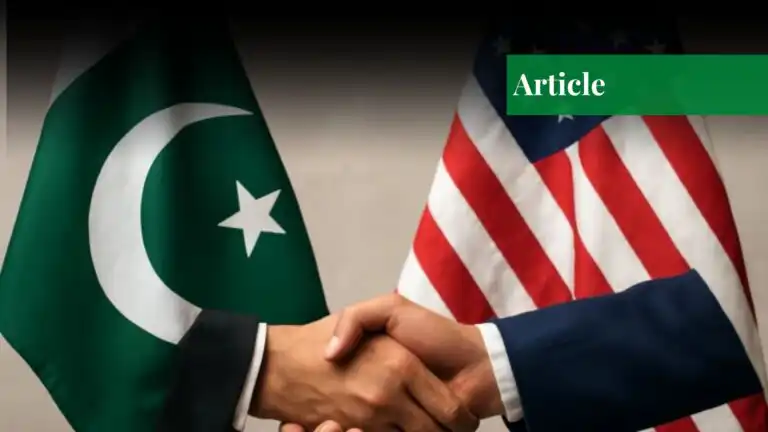
In a landmark development poised to reshape South Asia’s energy and trade dynamics, the United States and Pakistan concluded a comprehensive bilateral trade agreement on July 30–31, 2025. US President Donald Trump, in an official statement, hailed the pact as a “mutually transformative energy partnership,” marking a strategic re-engagement between Washington and Islamabad. At the heart of the US-Pakistan trade deal lies a commitment to co-develop Pakistan’s oil reserves, reduce tariffs on Pakistani exports, and strengthen bilateral trade relations across critical sectors, including energy, mining, and textiles.
The deal was finalized after months of high-level diplomatic engagements in Washington and Islamabad, spearheaded by Finance Minister Muhammad Aurangzeb and Foreign Minister Ishaq Dar on the Pakistani side. The agreement follows a backdrop of rising global energy prices, South Asian trade realignments, and Washington’s recalibration of regional policy amid deteriorating ties with India.
Framework of the US-Pakistan Trade Deal
US oil giants are expected to lead the exploration and development of Pakistan’s newly confirmed oil reserves, particularly in offshore zones and Balochistan. American companies such as Chevron and ExxonMobil are reportedly in line to secure licenses for upstream activities. US tariffs on Pakistani textile and leather exports, which currently range from 0% to 29%, will be significantly reduced, offering Pakistan greater market access and potential for export growth.
In return, Islamabad has offered zero-tariff concessions for American imports, including cotton, edible oils, and joint mining projects in resource-rich provinces. The US had previously expressed concern over Pakistan’s $3 billion trade surplus in 2024 (exports to the US: $5.1B; imports from the US: $2.1B). This deal aims to correct that imbalance through expanded bilateral imports and oil-sector joint ventures. In an unexpected strategic overture, Trump hinted at facilitating future Pakistani oil exports to India, depending on regional peace. He also referenced ongoing US mediation efforts regarding a ceasefire dialogue between India and Pakistan.
Energy Discoveries: From Promise to Production
The trade pact’s centerpiece is Pakistan’s recent petroleum discoveries, both offshore and onshore, signaling a long-awaited energy pivot for the country.
Indus & Makran Basins
In 2024, a three-year geological survey confirmed the presence of massive hydrocarbon deposits in Pakistan’s offshore territorial waters. The Indus and Makran basins, covering over 20,000 km², are estimated to hold significant natural gas and petroleum reserves. However, real commercial extraction is still years away and requires multi-billion-dollar investments.
Despite past offshore drilling failures (none of the 12 offshore wells drilled before 2009 yielded commercial success), the new US-Pakistan partnership may provide the technical and financial capacity required for deep-sea exploration, a sector long neglected due to high risks and low investor confidence.
Waziristan Block
While offshore fields remain dormant, the real excitement stems from Khyber Pakhtunkhwa’s Waziristan block, where a series of onshore discoveries have sparked optimism:
- In February 2025, the Spinwam-1 well yielded 12.96 million standard cubic feet per day (MMSCFD) of gas and 20 barrels/day of condensate.
- By March 25, 2025, Pakistan commenced production from the Shewa discovery, outputting 26 MMSCFD and 244 bpd of condensate.
- April witnessed back-to-back discoveries in the Kawagarh, Hangu, and Lockhart formations, with combined yields reaching over 100 MMSFCD and 400 bpd of condensate.
These discoveries, all led by Mari Petroleum in collaboration with OGDCL and OPI, mark the fastest transition from discovery to production in Pakistan’s history. To date, seven discoveries have been made, with production from at least one field already saving the country $300 million annually in import substitution.
Mari Energies has pledged $250 million in upstream investments in the Waziristan region, signaling a long-term commitment to expanding Pakistan’s domestic energy production.
Regional Mapping: Where Petroleum Could Shape Pakistan’s Future
Offshore development could establish Pakistan’s “blue water economy,” leveraging maritime assets for energy and mineral extraction, potentially transforming coastal provinces and port cities like Gwadar, envisioned as an oil‑city hub via mega‑projects backed by Saudi and Chinese investment (Gwadar Oil City project).
| Region | Status of Reserves | Key Players & Projects |
| Offshore Pakistan | Massive, survey-confirmed deposits in the Indus and Makran basins | Foreign‑backed consortia to bid for exploration rights |
| Balochistan (south) | Believed to hold substantial offshore reserves | Focus of US-Pakistani oil‑development deal |
| Sindh (e.g. Sawan, Adhi) | Producing gas (Sawan is nearly depleted) and older oil/gas fields | OMV, PPL, ENI, and OGDCL operate Sawan; the Adhi field is still under production in 2024 |
| Khyber Pakhtunkhwa (Waziristan) | Recent onshore oil & gas finds | Focus of US–US-Pakistani oil‑development deal |
Strategic and Economic Implications
With Pakistan’s annual crude imports nearing $16 billion, the potential to substitute domestic output could yield long-term macroeconomic relief. Moreover, petroleum sector growth can spur local employment, industrial demand, and downstream investment in refining, petrochemicals, and port development, particularly in Gwadar, envisioned as a future oil city.
This trade-energy partnership subtly signals a US policy shift in South Asia. With India facing 25% new tariffs (with 25% more tariffs announced on 7th Aug, 2025) on select exports under the Trump administration, Pakistan is emerging as a preferred partner. The deal may also serve as a counterweight to China’s growing grip over Pakistan’s infrastructure and energy sectors via the China–Pakistan Economic Corridor (CPEC).
Pakistan will receive its first shipment of US crude oil in October 2025, handled by Cnergyico and energy trading firm Vitol. This marks a symbolic and practical start to energy diversification; historically, Pakistan’s imports have been dominated by Gulf suppliers.
Challenges Ahead
Offshore extraction may take 4–5 years before yielding commercial output, with initial capital outlays exceeding $5 billion per block. Regions like Balochistan and Khyber Pakhtunkhwa remain vulnerable to unrest and Baloch nationalist opposition. Effective stakeholder management and local inclusion will be essential. Critics have raised concerns about exaggerated reserve estimates and the risk of political overpromising. Pakistan currently holds only 0.021% of global petroleum reserves, per some analysts, tempering expectations.
What to Watch For
As the US-Pakistan trade deal transitions from ink to implementation, key developments to monitor include:
- Which US firms ultimately secure exploration and development rights?
- Whether Pakistan’s offshore blocks (Makran/Indus) will finally receive sustained drilling activity.
- How provincial and federal governments engage local stakeholders, especially in volatile but resource-rich zones.
- Whether foreign exchange savings and new revenue streams will be reinvested into public services, infrastructure, or debt relief.
Final Reflection
The US-Pakistan trade and energy deal represents more than a bilateral accord; it’s a strategic pivot and a potential economic inflection point. If managed with technical expertise, institutional transparency, and political stability, the deal could catalyze Pakistan’s transition from an energy-deficient nation to a regional energy hub. The discoveries in Waziristan, combined with untapped offshore reserves, offer Pakistan a historic opportunity to rewrite its economic future. Yet success will depend not only on geological bounty but also on governance capacity, security stabilization, and policy continuity. In a region riven by rivalry and economic disparities, this partnership with careful stewardship might just become Pakistan’s most valuable asset.
If you want to submit your articles and/or research papers, please visit the Submissions page.
To stay updated with the latest jobs, CSS news, internships, scholarships, and current affairs articles, join our Community Forum!
The views and opinions expressed in this article/paper are the author’s own and do not necessarily reflect the editorial position of Paradigm Shift.

Mohammad Urva Rind is a student of Defence and Strategic Studies at Quaid-i-Azam University, Islamabad, with a keen interest in South Asian security and diplomacy, along with painting a positive image of Pakistan.