Introduction
The Indian Ocean is swiftly transforming into a melting pot of great power rivalry. From China’s great project of the Maritime Silk Road to India’s naval advancements and the presence of US naval bases in the Indian Ocean, the competition at the Seal Lines of Communication (SLOCs) is intensifying. In this context, ports such as Gwadar and Hambantota are potential pivot points for a shift in alliances and maritime tensions. This poses a serious quandary: by 2030, will Pakistan be able to transform its geography and strategic position, staking its place not as a pawn to great powers, but as a constructive maritime actor? The answer will determine if Pakistan will become a gateway for regional connectivity or a victim of the external powers.
The Indian Ocean in 2025
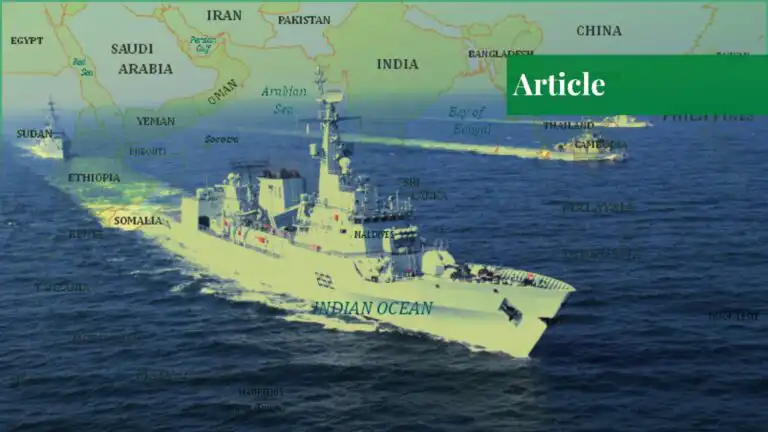
The Indian Ocean is known as the heart of global trade. More than three-quarters, roughly 75%, of maritime trade passes through its seas, while 35% of oil passes through the busiest strait, the Strait of Malacca, and 40% through the Strait of Hormuz; a small amount of trade is also conducted through the Bab el Mandeb.
Alongside these maritime chokepoints, India is enhancing its naval sites. Furthermore, India is now hosting its biggest-ever joint naval exercise with Africa as part of the Africa-India Key Maritime Engagement, in what is viewed as a move by the country to further expand its navy into the western Indian Ocean.
Additionally, China has been extending its naval presence into the Indian Ocean since 2008, fueled by developments such as seabed mapping for strategic asset protection and commercial interests—such as underwater terrain and resources. The question for Pakistan is whether it is capable of maneuvering these developing trends in the Indian Ocean to sustain its relevance as a significant regional player or succumb to becoming a cat’s paw for great powers.
Pakistan’s Maritime Assets and Geography
Pakistan has 1,046 kilometers of coastline along the Arabian Sea and the Gulf of Oman in the south, and is adjacent to India on the east of the coastline. Pakistan is strategically positioned near the world’s most critical SLOCs that connect Gulf states to Africa, Europe, and East Asia. This strategic position of Pakistan allows it to serve as a regional trade hub and maritime security stakeholder.
Three main seaports are being utilized in Pakistan, including Karachi Port – the main commercial gateway, Port Qasim with strong connectivity linkages to industry, and Gwadar Port, described as Pakistan’s “crown jewel” of maritime vision, which is near the Strait of Hormuz. As there are lots of resources available in the sea and the deeper seabed, Pakistan’s EEZ covers approximately 240,000 square km. km², being an area of fish concentration and seabed minerals; it has potential energy (hydrocarbons and offshore wind energy).
If these sources are managed sustainably, then they could significantly contribute to the GDP of Pakistan. Without a suitable budget and adequate investment, Pakistan risks remaining a bystander in the Indian Ocean despite the fact that in this region Pakistan holds natural advantages.
CPEC and Gwadar: Prospective or Politics of Strategic Burden?
Both the CPEC and Gwadar Port are the linchpins around which the Chinese BRI revolves. Strategically speaking, Gwadar gives China a direct route to the Indian Ocean, rendering its string of pearls project more powerful than ever. However, this project has some risks, such as debt sustainability. Due to this infrastructure, Pakistan is heavily relying on Chinese loans, and possibly shortly, Pakistan will be suffering from the same situation that Sri Lanka suffered due to its Hambantota Port. Also, there is a great risk to security for Chinese personnel, and sometimes there is a lack of coordination among Pakistani and Chinese personnel, which sometimes results in a delay in the success of this project. Due to these reasons, Gwadar is becoming a geopolitical liability rather than a driver of sustainable national development.
Pakistan Navy and Maritime Security Capacity
Pakistan’s navy forces posture focuses on coastal defense rather than blue-water operations. Pakistan’s Navy fleet includes four Tughril-class guided missile frigates, some offshore patrol vessels, and amphibious hovercraft. Pakistan’s navy also has Agosta-class diesel vessels for coastal deterrence and to enhance littoral defense. The navy has launched aerial platforms like Sea King helicopters, CH-4 MALE UAVs, jet-operated maritime patrol aircraft, and maritime radars and drones.
On the human capital and doctrinal front, the Pakistan Navy has advanced institutions. The PNS Rahbar offers training programs, Pakistan Navy War College, and the Maritime Centre of Excellence (MCE) launch policy research programs with strategic education in maritime affairs.
Still, there are some operational gaps, such as the fleet lacking robust anti-submarine warfare (ASW) tools and having limited shipbuilding capacity; also, Pakistan is highly dependent on China and Turkey. PNS Habitat fast attack craft marks progress, but these flaws are hindering Pakistan’s growth in the naval sector.
Regional and Extra-Regional Players: Threats and Opportunities
The maritime strategy landscape surrounding Pakistan is shaped by a web of regional and extra-regional actors. India is advancing and expanding its naval assets. It has built INS Vikrant, which is an aircraft carrier and a milestone in India’s naval progress, and India is also doing frequent naval exercises in the Indian Ocean, shaping itself as a naval power.
Meanwhile, China is advancing through dual-use hubs like Gwadar to get direct access to the Indian Ocean, which is strategically very important for China. This can also help Pakistan to become a naval actor. The United States remains a fundamental maritime actor due to its enduring freedom of navigation operations and port partnerships, especially through bases like Diego Garcia.
Middle Eastern and African littorals, including Iran, the UAE, and Somali territories, complicate the strategically sensitive region. Iran’s proxies are there, the UAE is expanding investments in ports, and Somalia’s piracy zones collectively touch Pakistan’s maritime security concerns. To avoid these cross-currents, Pakistan needs a multi-vector maritime strategy so that Pakistan can craft an active maritime posture, not a reactive one, to defend itself.
Scenarios for 2030 and Policy Recommendations
By 2030, Pakistan’s maritime path may take two directions, which are outlined through two scenarios below:
Scenario A: Pakistan Poised and Proactive
In this scenario, Pakistan is imagined as a nation that uses its geostrategic location through Gwadar and Karachi ports to maximize maritime domain awareness. If Pakistan expands satellite alliances and coastal radar integration, it would minimize reliance on one patron alone. Institutionalizing reforms within the Pakistan Coast Guard could support governance. Climate-resilient port infrastructure and disaster-response mechanisms would further make trade centers more resilient against extreme weather conditions.
Strategic Limbo of Scenario-B
This is the worst alternative, which is like a strategic compromise, succumbing to using Pakistan as a pawn by external forces. Myanmar defense appends would remain distinctly school of the fragmented manner, unilateral orientation towards one country, leading to the neutralization of Pakistan with curbs being put on it: supra-optimal illusion as Pakistan as cause of the problem rather solution to it.
To navigate towards the proactive scenario, there are some recommendations, which are as follows:
- Expand MDA capabilities through radars and satellites.
- Strengthen the coast guard and civilian maritime institutions.
- Increase developments in Gwadar.
- Diversify strategic and economic partnerships.
- Invest in human capital through blue economy training, as well as maritime laws and research.
By implementing these measures, Pakistan could transform from a reactive to a proactive maritime actor.
Conclusion
By 2030, Pakistan’s preparation to emerge as a significant maritime player can be termed moderate but conditional. Its strategic location, lengthy coastline, proximity to vital sea lines of communication, and ports are a good starting base. Projects like Gwadar development, connectivity associated with CPEC, and nascent blue-economy initiatives give concrete options of economic influence and regional clout. This, again, is highly conditional upon definitive policy decisions. Eventually, Pakistan’s 2030 maritime position does not merely depend on geography, but also on the nation’s capacity to make and conduct sustainable policies.
If you want to submit your articles and/or research papers, please visit the Submissions page.
To stay updated with the latest jobs, CSS news, internships, scholarships, and current affairs articles, join our Community Forum!
The views and opinions expressed in this article/paper are the author’s own and do not necessarily reflect the editorial position of Paradigm Shift.

Syeda Farani Fatima is an undergraduate student of International Relations at the International Islamic University of Islamabad, with a strong interest in anti-corruption, counter-terrorism and geopolitics. Strongly committed to fighting corruption, terrorism, and supporting national reform through research and public service.