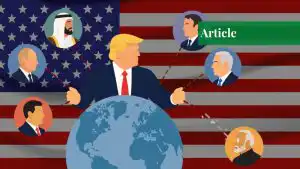


The comeback of Donald Trump as the frontrunner of the 2024 elections, after beating former Vice President Kamala Harris, has created an unpredictable political landscape, igniting debate worldwide. From loyal supporters who celebrate his unapologetic populism to critics who view him as forming upheaval in the democratic system, Trump winning the elections has raised unrelenting questions about the future of American politics. The nation has braced for yet another potentially contentious election cycle, and observing the implications of his administration reveals both opportunities and pitfalls that could alter the course of the United States for the next 5 years and its role on the global stage.

Domestic Policy Shifts for 2024
Securing the second term for the presidency in 2024, Trump vowed to tackle the country’s domestic issues, reinvigorating his stance on immigration, reproductive laws, economic nationalism and deregulation.
Trump’s immigration plan is set to be his most stringent yet. He promised to finish the border wall, dispatch troops to protect the border, and launch the largest deportation operation in US history, using 18th-century laws to remove undocumented immigrants. His merit-based immigration focus would restrict entry and end automatic citizenship for children born to immigrants. In addition to this, Trump aims to restore his travel ban on largely Muslim-majority countries and may establish detention camps for handling deportations. This aggressive agenda will likely face strong legal challenges and opposition in Congress.
Regarding deregulation, President-elect Donald Trump is focusing on removing or loosening many federal rules, particularly in energy, environment, and financial services. If Republicans control Congress, they could use the Congressional Review Act to reverse recent Biden-era principles. Trump’s outline may include cutting Environmental Protection Agency funding, overturning climate rules, and relaxing financial inaccuracy, including for cryptocurrency.
Trump is widely known and often criticised for his controversial stance on abortion, as he has repeatedly shifted his position throughout his campaign. While he once took credit for overturning Roe v. Wade, where the US Supreme Court reversed the constitutional right to abortion, he often states abortion laws should be decided by individual states. Despite this, scepticism remains, as Trump could also back using old laws, like the Comstock Act, to confine abortion pill access nationwide.
“America-first policy” comes yet another time when Trump’s administration aims to highlight economic nationalism centres on lowering taxes, cutting regulations, and strengthening the country’s industry. His policies aim to counter inflation by reducing government spending and boosting traditional manufacturing in sectors like energy and technology. By promoting US-made goods, the new president seeks to strengthen the economy through self-reliance and protect against global supply chain issues. Additionally, his potential tax cuts are directed towards investment but could widen income inequality and increase the deficit. This approach reflects a shift in prioritizing short-term growth over regulatory oversight.
Foreign Policy Revisions
Trump’s return has stirred a divided response worldwide. Allies grow guarded as his “America First” policy signals a move toward isolationism and closer ties with authoritarian leaders. Trump’s admiration for dictatorial leaders and scepticism of traditional alliances may deepen these global differences, redefining America’s role on the world stage and encouraging nationalist leaders to rally behind his approach.
His close alignment with Prime Minister Benjamin Netanyahu of Israel has been friendly since the days of his first term in 2016 and this posture will likely continue. It was during his administration that he brokered the Abraham Accords between Arab countries and Israel and the widely condemned movement of the US embassy from Tel Aviv to Jerusalem. However, during his campaign, he promised to get the Israel-Palestine conflict settled but it’s unlikely this will happen as Trump is most expected to continue to arm Israel due to historical and political linkages. As a concern of the Russia-Ukraine war, Trump exclusively said that he would resolve it within 24 hours of his office. To maintain ties with Russia, he said that President Volodymyr Zelenskyy of Ukraine may have to yield some of his territory, a suggestion which the country has been frequently rejecting.
The geopolitics of two superpowers of the world may be reflected in Trump’s policies, as China braces for another trade war accentuating economic confrontation, and focusing on tariffs and trade issues. His strategy is to maintain high tariffs and possibly impose a blanket 10% tariff on imports, with even greater rates for Chinese goods. Although he has voiced respect for President Xi, Trump’s attitude remains tough, ranking US economic interests. Impending changes include revoking China’s Most Favored Nation status, leading to increased tariffs. These pressures also span Taiwan, the South China Sea, and military competition as Trump exaggerates his competitive approach toward China.
Moreover, America’s neighbour in the south, Mexico may face more disruptive implications, of Trump winning a second administration, with him deploying US troops to combat drug cartels, imposing high tariffs, and initiating a large-scale deportation effort, which could deeply impact Mexico’s economy and society. Despite reassurances from Mexico’s current president Claudia Sheinbaum, the consequences for trade, security, and migration may skyrocket.
In his first term, Trump was criticised for multilateralism and international organizations, including NATO and the UN as he withdrew from key agreements like the Paris Climate Accord and disapproved of NATO allies for not paying their fair share. In a second term, Trump could push for even more commotion in global cooperation, perhaps threatening the G7 and questioning NATO’s role. European nations fear the impact of his policies on security and economic collaboration.
Trump’s administration is far from a simple continuation of his earlier presidency. With new and pressing global issues ranging from climate crises to intensifying geopolitical conflicts, Trump’s arrival could mean steering uncharted territory. Whether regarded as a path in the direction of reestablishing American strength or as a danger to democratic institutions, the repercussions are profound. As America awaits with anticipation, the rest of the world, too, stands on edge, expecting the direction that Trump 2.0 might navigate.
If you want to submit your articles and/or research papers, please check the Submissions page.
The views and opinions expressed in this article/paper are the author’s own and do not necessarily reflect the editorial position of Paradigm Shift.

She is a student of international relations, pursuing a bachelor’s degree in the field from Bahria University. With a deep interest in global affairs, she writes on topics related to geopolitics and international dynamics, aiming to contribute thoughtful analysis on contemporary global issues.