“The whole earth is a sepulchre of famous men”
– Thucydides, History of the Peloponnesian War.
An army is a strange entity. It is an organised institution, deliberately trained, equipped and structured for one fundamental purpose: to impose its will upon a defined enemy through controlled violence.
Its success is measured not merely in territory gained or objectives captured, but in the destruction of the enemy’s capacity to fight — through the loss of life and limb, the destruction of equipment and infrastructure, and the disruption of its ability to continue the struggle. In almost every other human institution, causing such destruction would be a crime. In an army, when directed against a lawful enemy and within the rules of war, it is the very purpose for which the institution exists.
The paradox, therefore, is that an army is not inherently a violent organisation gone wrong. It is a violent instrument deliberately created by the state and constrained by law, discipline and command precisely so that violence can be applied in a controlled manner. And therein lies the real question: if the instrument is designed to destroy an external enemy, what happens when the institution itself becomes part of the political contest within the state? Or worse still, turns upon its own.
That is where the distinction between the army as an institution and the system in which the army operates becomes critical. To draw simplistic conclusions from the colonial period and then somehow blame “colonial values” for the madness that followed makes little sense.
First, the environment of the time matters. Serving in the British Indian Army did not make a man a traitor or a collaborator; in the legal and political reality of the time, we were British Indian subjects and, after 1947, citizens of Pakistan. Until 1956, Pakistan itself was a Dominion of the British Commonwealth. To judge people retrospectively by standards that did not exist at the time is simply unfair. Colonial Legacy and Historical Pride
In the colonial setting, names such as Warburton, Olaf Caroe, Nicholson and Alexander Keppel belong to a history that cannot simply be dismissed because the political system of the time was colonial. They were products of their age, but they were also individuals whose courage, leadership, scholarship, administration and service left a lasting mark on the region. To acknowledge that history is not to endorse colonialism; nor is it to surrender the right to be proud of the institutions, traditions and people that formed part of our inheritance.
History does not become dishonourable merely because the flag under which it was made was foreign. The courage of a soldier, the integrity of a commander, or the achievements of an institution are not erased by the politics of the sovereign. We can condemn colonial rule where it deserves condemnation while still recognising extraordinary individuals who served in that era. Indeed, a mature nation does not inherit history selectively: it examines it, owns it and draws from both its virtues and its failures.
That is precisely why a regiment such as Sam Browne’s Own need not apologise for its colonial heritage. Its history belongs to the regiment, and subsequently to Pakistan, as much as to the empire in which it originated. Universally recognised by almost every army of the world, which chooses to wear the belt the regiment invented, to display it as a badge of honour and courage – not colonialism. The men who served in it were not abstractions of colonial policy; they were soldiers, with their own courage, loyalties, sacrifices and traditions. Their history can be examined critically without being reduced to the single word “colonial.”
The past is not a stain to be washed away. It is an inheritance to be understood.
And what exactly are we supposed to call these soldiers—patriots or collaborators, over the subcontinent’s history of thousands of years? Will each era, every decade, any age, produce its separate sets of heroes, soldiers and warriors – who will define what values are kosher and which are not during these varying periods of history? Who has the right to judge others for the lives they lived in honour, loyalty and dedication to a sovereign they believed they were a part of? India had been invaded repeatedly from the north, the west and the south throughout its history. Armies changed allegiance, rulers changed, empires came and went, and the political meaning of loyalty changed with them – so how are the descendants defined – as traitors or patriots? So when, precisely, was a soldier supposed to know that he was a “patriot” and when he was a “collaborator”? Was he expected to carry a crystal ball into battle? History needs context, not hindsight masquerading as morality. People should be judged within the political and legal circumstances in which they actually lived, not by the political vocabulary we have invented decades later.
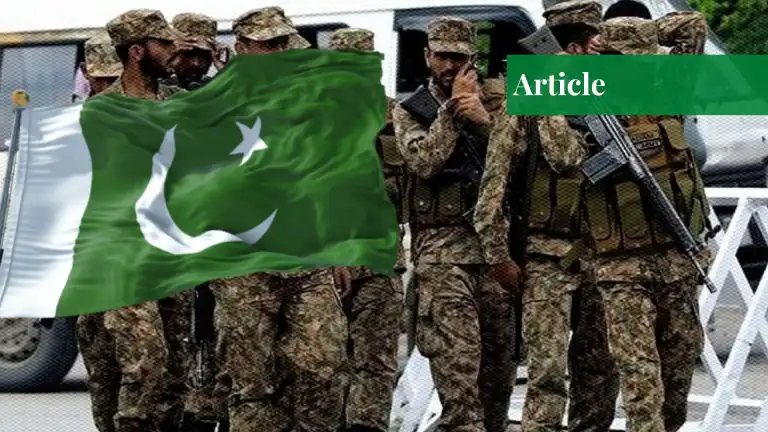
The Army I served in was Pakistan’s Army — but it was also, institutionally and historically, the inheritor of the British Indian Army. We did not create that history; we inherited it, along with its traditions, structures and professional ethos. I have no difficulty acknowledging the faults within our own institution. I have served long enough to know that institutions, like individuals, are neither sacred nor infallible. I have the depth to own our mistakes, but I will not manufacture excuses for them — nor will I accept the convenient argument that every failure in Pakistan’s political history can simply be placed at the Army’s door.
And let us not pretend that Pakistan’s history began with the Army intervening in politics. We have had our Mir Jafers, collaborators and political opportunists throughout our history. The uncomfortable truth is that civil and military actors have repeatedly interacted, bargained, invited, enabled and ultimately shared responsibility for the mess. Look at the record: Was Ayub Khan not invited into the civilian cabinet as a serving Commander-in-Chief and made Defence Minister in 1954
— an extraordinary arrangement by any standard? Contemporary accounts record that the serving Army chief became part of the cabinet at precisely the moment when the civilian political system was struggling to establish itself.
Was Zia-ul-Haq not selected as Army Chief in 1976 despite seven senior lieutenant generals being ahead of him? He was indeed promoted over seven seniors. That was a political appointment made by a civilian Prime Minister — not a military seizure of the appointment.
And in 1999, did the Army simply wake up one morning and decide to overthrow the government? Nawaz Sharif dismissed General Musharraf while Musharraf was returning to Pakistan by air and attempted to replace him with General Ziauddin. The aircraft, with limited fuel, was carrying nearly 200 passengers and was denied permission to land, jeopardizing those lives. What followed was the military takeover of 12 October. The precise interpretation of the events — including who intended what and when — remains contested, but the immediate crisis certainly did not occur in a political vacuum or as an attempt to install a favourite general –nepotism?
Then look at the present: The 2024 election produced serious and continuing disputes over the counting and consolidation of results. PTI alleged that Form 47 results had been altered in several constituencies, while the subsequent coalition government was formed through negotiations between political parties after no party obtained a parliamentary majority. Those are facts of the political aftermath; the allegations concerning manipulation and alleged political-military arrangements remain matters of dispute and should be described as such.
My point is therefore not that the Army is innocent. It is that the Army cannot be examined in isolation from the political system that repeatedly promoted, invited, empowered, negotiated with, resisted, and eventually blamed it. If we are going to have an honest conversation about Pakistan, then let us stop looking for one guilty institution and start examining the system that produced the recurring relationship between politicians, bureaucracy, judiciary, business interests, and the military. I am quite prepared to put the Army’s mistakes on the table.
But if we are going to put the Army’s sins on trial, then let us have the courage to call the witnesses from the other side of the table as well because the present is what matters. History can explain the disease. It cannot be allowed to become an excuse for avoiding the diagnosis of the patient sitting in front of us today. This Is Not a Colonial Army. The argument that Pakistan’s Army remains a “colonial Army” and therefore naturally interferes in politics confuses institutional ancestry with constitutional identity.
Pakistan inherited the British Indian Army in 1947—its regimental traditions, discipline, hierarchy, and professional ethos. Some regiments proudly trace their lineage to 1857 and earlier. But a regiment inherits its history; it does not inherit the political allegiance of the sovereign for whom its predecessors once fought. The crucial transformation occurred after independence.
However, the first major turning point was the Objectives Resolution of 1949. It did not immediately turn the Army into an ideological institution, but it began changing the ideological and constitutional character of the State in which the Army served. The declaration that sovereignty belonged to Allah, and that authority was to be exercised as a sacred trust, introduced a conception of State legitimacy that was different from the essentially secular-professional framework inherited by the military institution. Over subsequent decades, that ideological character increasingly penetrated State institutions, including the Army. The decisive institutional expression came under Zia-ul-Haq, when “Unity, Faith, Discipline” was replaced by “Iman, Taqwa, Jihad fi Sabilillah.”
That was not colonialism. It was a post-independence ideological transformation of a Pakistani institution. The second turning point—and perhaps the greatest warning—was 1971. The breakup of Pakistan cannot credibly be attributed simply to a colonial military mentality. Its principal causes were generated within Pakistan: constitutional failure, the inability to accommodate the electoral mandate of the Awami League, political rivalry, regional and economic grievances, administrative dysfunction, mistrust between East and West Pakistan, military involvement in a fundamentally political crisis, and failures of leadership and decision-making. Nepotism and patronage within the political and administrative system also contributed to the broader institutional weakness. India’s intervention ultimately converted the crisis into military defeat, but the internal political crisis had already become catastrophic. The causes were overwhelmingly Pakistani, not colonial.
1971 therefore demonstrates something fundamental: Pakistan’s most consequential civil–military failures cannot simply be explained by the Army’s British ancestry. The Army of 1971 was already a Pakistani National Army, operating under Pakistani political institutions and Pakistani leadership. The real causal chain, where history is better understood as:
- Professional national Army after 1947
- Objectives Resolution and ideological transformation of the State
- Weak constitutional and civilian institutions
- Civilian reliance upon the military
- Politicisation of the Army
- 1971: catastrophic failure generated largely by Pakistan’s own political and institutional weaknesses
- Repeated erosion of the boundary between military and political authority
- Greater scope for an individual Chief to exploit intelligence, institutional power and constitutional ambiguity.
- Army props up an artificial government to acquire constitutional cover, and then operates under that constitutional protection all the while manipulating the government as it wants to. Nothing colonial about this.
The colonial explanation is inadequate. The Army did not inherit political intervention from the British. Pakistan progressively created the conditions for it. History does not support the argument that the Pakistan Army is colonial. Who is the Army colonizing? Colonialism was a political system; soldiering was a profession; loyalty was owed to the sovereign and the oath of the time. To confuse the first with the last is not historical analysis—it is retrospective moral labelling.
Civilian politicians repeatedly invited the Army into political disputes. Governments relied upon intelligence institutions against political opponents. Constitutional institutions were weakened. Political patronage and nepotism undermined institutional legitimacy. And when civilian mechanisms failed, the Army was repeatedly asked to fill the resulting vacuum.
The irony is that the institution most often blamed for entering politics was frequently invited into politics by politicians themselves. Once inside, however, the distinction between assistance and intervention became increasingly blurred. That is where the responsibility of the military leadership becomes critical.
A young officer’s oath is to Pakistan, the Constitution and the law—not to the personal political preferences of his Chief. The Chief commands the Army; he does not own the Constitution. Article 245 provides a constitutional role for the Armed Forces in defence and, subject to law, in aid of civil power. It does not make the Army the arbiter of political legitimacy. Consequently, if a Chief uses the Army or intelligence apparatus to influence political outcomes, that should be understood as a constitutional and institutional aberration, not as evidence that the Army is somehow still colonial. Subordinates are presented with a confusing and ambiguous justification –
The Army’s deployment in aid of civil power is, in itself, a constitutional mechanism, even where the government invoking it may be politically or constitutionally contested. For the soldier, however, the distinction is fundamental: the rank and file are not ordinarily required to adjudicate the legitimacy of the government of the day, nor are they in a position to do so once a competent civilian authority issues an order through the constitutionally prescribed chain of command, the soldier’s duty is to obey it, subject to the law and the military code.
To require individual soldiers to determine whether the government issuing the order is legitimate would effectively place political judgment in the hands of the military—precisely the boundary that military propriety is intended to prevent. Thus, the soldier is insulated from the political question of legitimacy: he serves the state through its established institutions, rather than deciding which government has the right to govern.
The institutional Army should not automatically be equated with the political conduct of a particular Chief or government. 1971 demonstrated the consequences of Pakistan’s own political, constitutional and institutional failures—including political patronage, nepotism, regional grievances, leadership failures and the misuse of military power to confront essentially political problems. Neither development can reasonably be blamed upon the British Army of 1857.
The central conclusion: this is not a colonial Army. It is a Pakistani national institution with colonial ancestry, transformed by nearly eighty years of Pakistani political, constitutional and ideological experience. The colonial past explains the Army’s regimental traditions. It does not explain its political behaviour in Pakistan today. The deeper explanation is more uncomfortable: Civilian weakness created the space. Civilian politicians repeatedly invited the Army into that space. The Objectives Resolution helped begin the ideological transfer. The ideological transformation of the State changed the Army’s institutional environment. Constitutional ambiguity failed to close the political boundary. And an assertive Chief can exploit that accumulated weakness.
Therefore, if the Army interferes in political affairs today, the proper question is not: “Why is this colonial Army still behaving like a colonial Army?” It is: “Why has Pakistan, after nearly eighty years of independence, still failed to establish and enforce an institutional boundary that keeps the Army out of politics?”
That is a Pakistani failure—not a colonial inheritance.
The walls of Sparta were its men.
– Lycurgus/Spartan Tradition.
Find our FREE quizzes and MCQs here!
If you want to submit your articles and/or research papers, please visit the Submissions page.
To stay updated with the latest jobs, CSS news, internships, scholarships, and current affairs articles, join our Community Forum!
The views and opinions expressed in this article/paper are the author’s own and do not necessarily reflect the editorial position of Paradigm Shift.