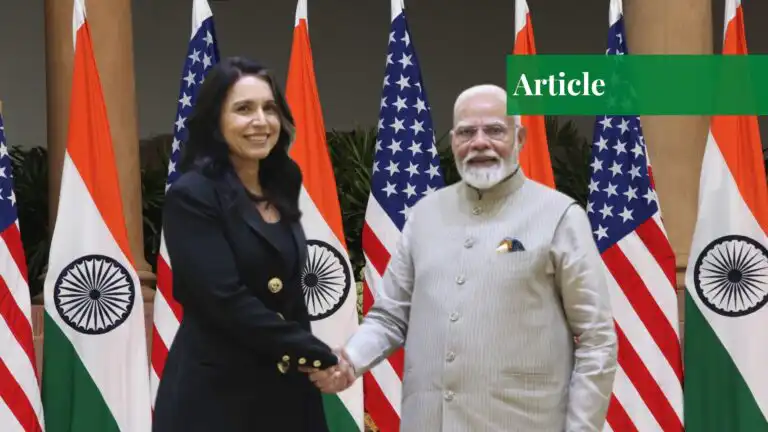
In his treatise “Arthashastra,” Chanakya Kautilya, while giving his 6-fold policy, said, “A king must forge an alliance with a superior king to strengthen his own position.” Military-to-military relations and intelligence cooperation are significant parts of fostering bilateral bonds. The political governments may change, and relations might evolve, but the military and strategic contacts between states are everlasting until and unless the national interest of the countries is preserved. On the 18th of March, 2025, the US Director of National Intelligence (DNI), Tulsi Gabbard, paid a high-level visit to India. The timing of this visit holds value and significance as the geopolitical dynamics are constantly changing and the world order is relocating itself. Tulsi Gabbard met with her Indian counterparts, including Prime Minister Modi and Minister of External Affairs of India S. Jaishankar, and addressed the nation at Raisina Dialogue, India.

Historical Context
The Indo-US cooperation in counterterrorism has seen considerable progress in intelligence sharing, information exchange, operational cooperation, counterterrorism technology, and equipment. The Indo-US Counterterrorism Cooperation Initiative (CCI) was signed in 2010 to expand collaboration on counterterrorism and capacity building. As of November 2010, during President Obama’s visit to India, a Homeland Security Dialogue was announced to deepen counterterrorism efforts further. Two rounds of this dialogue have been held in May 2011 and 2013.
In December 2013, the Indo-US Police Chief Conference on Homeland Security was organized in New Delhi. To further enhance the intelligence cooperation between India and the US, an arrangement was concluded in June 2016 to facilitate the exchange of terrorist screening information through the designated contact points. Both states have a joint platform, the Indo-US Counterterrorism Joint Working Group, for sharing and exchanging information.
Later, in March 2024, a security dialogue was concluded in which the US and India discussed mutual concerns over terrorism, including the presence of pro-Khalistan elements on US soil and the extradition of Tahawwar Hussein Rana, accused of involvement in the Mumbai terror attacks. India and the US have launched a “Defense Technology and Trade Initiative” (DTTI) aimed at simplifying technology transfer policies and exploring possibilities of co-development and co-production to invest the defense and intelligence relationship with strategic value. According to the Stockholm International Peace Research Institute, India was the world’s second-largest importer of arms in the 2014-19 period, after Saudi Arabia. During the period, India bought $16.7 billion worth of arms, 9.7% of the world total.

Key Features and Consultations
The prime motive behind the India visit of Tulsi Gabbard is to enhance and boost the already developed intelligence-sharing network between the two countries and to modify the network by the changing world order. Following the historical context, the visit aims to bolster ties regarding issues of non-traditional security threats, state and non-state cyberattacks, and the rising wave of extremism. During an interview with an Indian journalist, Tulsi Gabbard explicitly mentioned the emergence of extremism and radicalism, specifically Islamic extremism, as a threat to US national security.
The visit also underscores an increase in cooperation in the domains of advanced technologies and cybersecurity. Both states have agreed to enhance their bilateral connections over cyber and space defense and explorations and, in particular, artificial intelligence. As both countries have already signed an agreement on the “US-India Initiative on Critical and Emerging Technology” (iCET), the newly paid visit of the American DNI will reinforce the technological ties between the two states.
Other than political or strategic dynamics, the visit holds a culture-oriented approach. As the US DNI, Tulsi Gabbard, is a Hindu member of Trump’s cabinet, she has very strong and deep relations with her Indian counterparts. Despite differences at some points, this cultural coherence will further promote more cooperative efforts from both sides.
Indo-US Threat Perceptions in the Region
The China Factor
The militarization of the Indo-Pacific region by the US and its extraordinary alliance with India is a clear attempt to contain the threat of the People’s Republic of China (PRC). According to the US, the assertive and harsh approach of China towards international waters in the South China and East China seas is making the region unstable, deteriorating the US interests there. From Obama’s “Pivot to Asia” to Biden’s “Indo-Pacific Strategy,” the US has maintained strategic relations with India to counter the alarming rise of China in the region. In its 2022 Indo-Pacific strategy, the US had talked about a free, resilient, and prosperous Indo-Pacific region with China working as a semi-periphery state while the core status is retained by the US.
With the exchange of intelligence and procurement of military weapons by both states, the US is trying to reset the balance that resonated with the Indian hegemonic designs in the region. An Indo-centric South Asia is a need of the US in the current scenario. China’s growing profile and the strengthening of its foothold in the region, with close ties to periphery states under its debt trap diplomacy, are hurting the US the most. As Donald Trump’s 2025 administration is promoting the sentiments of “Make America Great Again, Indian Prime Minister Modi has announced to “Make India Great Again” or “India First.” The visit of Tulsi Gabbard to India is based explicitly upon containing China by increasing defense and security contacts between the US and India.
The Bangladesh Factor
At the time of Sheikh Hasina’s regime, India enjoyed friendly relations with its Bangladeshi counterparts. Bangladesh provides a very critical and strategic backyard to India to check Pakistan’s activities in the wider Indian Ocean region. The Bay of Bengal provides India with strategic points to counter and assert hegemony over Pakistan. But the June 2024 revolution in Bangladesh toppled the regime of Sheikh Hasina and resulted in the release of not only the opposition leaders but also the banned Islamic extremist organizations like Hizb al Tahrir and Jamaat-i-Islami.
Similarly, after the regime change, the interim government started to revive its relations with Pakistan. Just a few months ago, there was a high-level exchange of military personnel between Pakistan and Bangladesh, with some reports mentioning the emergence of Pakistan’s intelligence services in Bangladesh. This is a clear threat to India and a defeat by losing its significant partner in the region. The US DNI Tulsi Gabbard, while giving an interview to Indian journalists during the India visit, said, “The rising of Islamic extremism and radicalism in Bangladesh is a clear threat to the US national security and to the region.” This statement depicts that the Bangladesh factor was central during the talks with Indian officials.
The Pakistan Factor
The procurement of military weapons by India from the US is seen as a clear threat and a promoter of power imbalance in the region by Pakistan’s strategic thinkers. The growing contacts between the US and Indian intelligence agencies and the acquisition of sophisticated and advanced weapons by India are not only to counter China’s threat; rather, India utilizes this to contain and assert influence on Pakistan. In 2024, the US imposed sanctions on Pakistan’s ballistic missile program, and as of 2025, the US has once again attacked Pakistan’s nuclear program through sanctions, banning 19 Pakistani companies.
The isolationist policies of Trump’s administration have forced Pakistan to completely tilt toward China and Russia, while India’s complete tilt toward the US is visible. During a press conference in the US Oval Office, Prime Minister Modi explicitly declared that India is not a non-aligned state. This statement clearly shows that power blocs are again emerging, and Cold War 2.0 is on its path. Thus, the US DNI’s visit to India is taken as a message by Pakistan that the US wants India as its critical ally, neglecting Pakistan and even sanctioning its missile program.
Conclusion
Tulsi Gabbard, the US Director of National Intelligence, visited India, showing how global intelligence partnerships keep changing. As security threats get more complex, sharing intelligence and working together remain crucial for international security. To conclude, what comes out of this visit will affect how intelligence agencies team up in the coming years, making the US and its allies work even closer together.
If you want to submit your articles and/or research papers, please visit the Submissions page.
To stay updated with the latest jobs, CSS news, internships, scholarships, and current affairs articles, join our Community Forum!
The views and opinions expressed in this article/paper are the author’s own and do not necessarily reflect the editorial position of Paradigm Shift.

Syed Hammad Ali is pursuing a BS in International Relations programme from the International Islamic University, Islamabad, and has a keen interest in research works, policy analysis, defence and strategic studies, and conflict resolution.